Pages

Saturday, October 31, 2009

VTC Prayer For the Dead Compilation

Halloween is the eve of the Feast of All Saints. For many, it is a time to remember and pray for the dead. Here are some of our previous posts of interest.

Elena writes about prayers to and for the dead.

Erika directs us to a history of All Hallow's Eve.

Jimmy Akin gets me musing about what the point would be to NOT pray for the dead.

Candy accuses us of necromancy by saying that we are speaking to the dead.

Some parts of my post on purgatory are also relevant:
2 Tim. 1:16-18 is an example of Paul praying for the dead, in this case, a man named Onesiphorus.

Praying for the dead was common practice among the Jews at that time. It has been the practice at least as long as the time of the Maccabees. 2 Maccabees 12:43–45 states "In doing this he acted in a very excellent and noble way, inasmuch as he had the resurrection of the dead in view; for if he were not expecting the dead to rise again, it would have been useless and foolish to pray for them in death. But if he did this with a view to the splendid reward that awaits those who had gone to rest in godliness, it was a holy and pious thought. Thus he made atonement for the dead that they might be freed from this sin." These verses are the primary reason that the deuterocanonical books were removed from the Old Testament. They justified praying for the dead.

Praying for the dead remains the Jewish practice today. Orthodox Jews recite the Kaddish for eleven months after the death of a parent, to pray for their purification. Judaism 101 says "According to Jewish tradition, the soul must spend some time purifying itself before it can enter the World to Come."

While many contend that purgatory and praying for the dead was a medieval Roman Catholic invention, there is ample evidence that this was a belief of the early Christians. Visit the catacombs, and you find prayers for the dead scrawled on the wall in examples of graffiti dating to the first three centuries of Christianity.

Other writings of that era such as Acts of Paul and Thecla and the Martyrdom of Perpetua and Felicity also attest to this belief.

The Early Church Fathers, who, being "early" predated Medieval times by quite a bit, also wrote on this topic. Tertullian, writes in the second century, "We offer sacrifices for the dead on their birthday anniversaries [the date of death—birth into eternal life]."
Plus, who says Halloween more than Jack Chick!

Joe Carter takes a stroll down memory lane as he contemplates the annual ritual of handing out Chick tracts with Halloween treats.

To me, though, Chick is not just another anti-Catholic bigot. When I was a kid Jack Chick was the man who was responsible for more nightmares than the Twilight Zone and Kolchak: The Nightstalker combined. Chick not only scared the hell out of me, he made me afraid that hell was all around me.


AddThis Social Bookmark Button

Sunday, October 25, 2009

Apostolic Succession

Before we begin on the issue of apostolic succession, we first must discuss the nature of the priesthood. Some Christian churches do not believe in any sort of ordination. They feel that because of the priesthood of all believers, any member of the church may preach and lead their assembly. Others do practice a laying on of hands for ordination, seeing it as a symbolic act, similar to baptism.

For Catholics, ordination is a sacrament. Through ordination, a man becomes a priest, his priesthood indelibly imprinted on his soul, forever. Although many Christians feel that the priesthood ended with Christ, Catholics see the Levitical priesthood as a prefiguring of the ordained ministry of the New Covenant. As the Catholic Catechism explains:

1544 Everything that the priesthood of the Old Covenant prefigured finds its fulfillment in Christ Jesus, the "one mediator between God and men." The Christian tradition considers Melchizedek, "priest of God Most High," as a prefiguration of the priesthood of Christ, the unique "high priest after the order of Melchizedek"; "holy, blameless, unstained," "by a single offering he has perfected for all time those who are sanctified," that is, by the unique sacrifice of the cross.

1545 The redemptive sacrifice of Christ is unique, accomplished once for all; yet it is made present in the Eucharistic sacrifice of the Church. The same is true of the one priesthood of Christ; it is made present through the ministerial priesthood without diminishing the uniqueness of Christ's priesthood: "Only Christ is the true priest, the others being only his ministers."

This is important to note in the face of the accusation that Catholic priests are usurping the place Christ, who is our only true priest.

The Catholic Church does recognize the priesthood of all believers, or baptismal priesthood. The role of the ordained priesthood is to serve the rest of us, through dispensing the sacraments.

1120 The ordained ministry or ministerial priesthood is at the service of the baptismal priesthood. The ordained priesthood guarantees that it really is Christ who acts in the sacraments through the Holy Spirit for the Church. The saving mission entrusted by the Father to his incarnate Son was committed to the apostles and through them to their successors: they receive the Spirit of Jesus to act in his name and in his person. The ordained minister is the sacramental bond that ties the liturgical action to what the apostles said and did and, through them, to the words and actions of Christ, the source and foundation of the sacraments.

But how does the ordained priesthood have the authority to marry people, to forgive sins, etc? They were given this authority by Jesus, as it was passed down through the apostles.


And Moses said, Hereby ye shall know that the LORD hath sent me to do all these works; for I have not done them of mine own mind. Num 16:28

God gives Moses the authority to perform works on his behalf.

I can of mine own self do nothing: as I hear, I judge: and my judgment is just; because I seek not mine own will, but the will of the Father which hath sent me. John 5:30

In the same way, Jesus, as a man, acts under the authority of the Father.

And I appoint unto you a kingdom, as my Father hath appointed unto me Luke 22:29
Then he called his twelve disciples together, and gave them power and authority over all devils, and to cure diseases. Luke 9:1

Jesus gives this authority to his disciples.

And with that he breathed on them and said, "Receive the Holy Spirit." John 20:22

God imparted life to Adam through breathing on him. Therefore, this breathing was not just a symbol, but a sacrament. An outward sign of an inward grace which they received. This is something which they knew would be passed on to those who would come after them.

Acts 1:20-26 For it is written in the book of Psalms, Let his habitation be desolate, and let no man dwell therein: and his bishoprick let another take. Wherefore of these men which have companied with us all the time that the Lord Jesus went in and out among us, Beginning from the baptism of John, unto that same day that he was taken up from us, must one be ordained to be a witness with us of his resurrection. And they appointed two, Joseph called Barsabas, who was surnamed Justus, and Matthias. And they prayed, and said, Thou, Lord, which knowest the hearts of all men, shew whether of these two thou hast chosen, That he may take part of this ministry and apostleship, from which Judas by transgression fell, that he might go to his own place. And they gave forth their lots; and the lot fell upon Matthias; and he was numbered with the eleven apostles.

As this article from This Rock explains, "Peter considers Judas’s betrayal as a fulfillment of Old Testament prediction. And he also quotes from the Greek Septuagint translation of Psalm 109:8 (Psalm 108:8 in the Septuagint numbering) to show that filling the office was foreseen in Scripture. Verse 20 reads, "His office let another take." The word translated "office" is episkope, which in New Testament language means "episcopal office" (see 1 Tim. 3:1)."

Acts 9:7 shows that even Paul was ordained before he begins his ministry. And Ananias went his way, and entered into the house; and putting his hands on him said, Brother Saul, the Lord, even Jesus, that appeared unto thee in the way as thou camest, hath sent me, that thou mightest receive thy sight, and be filled with the Holy Ghost. Paul sees this ministry being passed down through the generations, "And the things that thou hast heard of me among many witnesses, the same commit thou to faithful men, who shall be able to teach others also." (2 Tim. 2:2).

So, the apostles received this authority from Jesus, which they passed down to their successors, which they passed down through the generations, and which we still recognize today, as do a few other churches. The Catechism explains it in this way:

1562 "Christ, whom the Father hallowed and sent into the world, has, through his apostles, made their successors, the bishops namely, sharers in his consecration and mission; and these, in their turn, duly entrusted in varying degrees various members of the Church with the office of their ministry." "The function of the bishops' ministry was handed over in a subordinate degree to priests so that they might be appointed in the order of the priesthood and be co-workers of the episcopal order for the proper fulfillment of the apostolic mission that had been entrusted to it by Christ."

1563 "Because it is joined with the episcopal order the office of priests shares in the authority by which Christ himself builds up and sanctifies and rules his Body. Hence the priesthood of priests, while presupposing the sacraments of initiation, is nevertheless conferred by its own particular sacrament. Through that sacrament priests by the anointing of the Holy Spirit are signed with a special character and so are configured to Christ the priest in such a way that they are able to act in the person of Christ the head."

1564 "Whilst not having the supreme degree of the pontifical office, and notwithstanding the fact that they depend on the bishops in the exercise of their own proper power, the priests are for all that associated with them by reason of their sacerdotal dignity; and in virtue of the sacrament of Holy Orders, after the image of Christ, the supreme and eternal priest, they are consecrated in order to preach the Gospel and shepherd the faithful as well as to celebrate divine worship as true priests of the New Testament."

1565 Through the sacrament of Holy Orders priests share in the universal dimensions of the mission that Christ entrusted to the apostles. The spiritual gift they have received in ordination prepares them, not for a limited and restricted mission, "but for the fullest, in fact the universal mission of salvation 'to the end of the earth," "prepared in spirit to preach the Gospel everywhere."

1566 "It is in the Eucharistic cult or in the Eucharistic assembly of the faithful (synaxis) that they exercise in a supreme degree their sacred office; there, acting in the person of Christ and proclaiming his mystery, they unite the votive offerings of the faithful to the sacrifice of Christ their head, and in the sacrifice of the Mass they make present again and apply, until the coming of the Lord, the unique sacrifice of the New Testament, that namely of Christ offering himself once for all a spotless victim to the Father." From this unique sacrifice their whole priestly ministry draws its strength.

1567 "The priests, prudent cooperators of the episcopal college and its support and instrument, called to the service of the People of God, constitute, together with their bishop, a unique sacerdotal college (presbyterium) dedicated, it is, true to a variety of distinct duties. In each local assembly of the faithful they represent, in a certain sense, the bishop, with whom they are associated in all trust and generosity; in part they take upon themselves his duties and solicitude and in their daily toils discharge them." priests can exercise their ministry only in dependence on the bishop and in communion with him. The promise of obedience they make to the bishop at the moment of ordination and the kiss of peace from him at the end of the ordination liturgy mean that the bishop considers them his co-workers, his sons, his brothers and his friends, and that they in return owe him love and obedience.

1568 "All priests, who are constituted in the order of priesthood by the sacrament of Order, are bound together by an intimate sacramental brotherhood, but in a special way they form one priestly body in the diocese to which they are attached under their own bishop. . . ." The unity of the presbyterium finds liturgical expression in the custom of the presbyters' imposing hands, after the bishop, during the rite of ordination.


Our records of the early church attest to their belief in apostolic succession.

"Through countryside and city [the apostles] preached, and they appointed their earliest converts, testing them by the Spirit, to be the bishops and deacons of future believers. Nor was this a novelty, for bishops and deacons had been written about a long time earlier.... Our apostles knew through our Lord Jesus Christ that there would be strife for the office of bishop. For this reason, therefore, having received perfect foreknowledge, they appointed those who have already been mentioned and afterwards added the further provision that, if they should die, other approved men should succeed to their ministry." (Clement of Rome, Epistle to the Corinthians 42:4-5, 44:1-3 [A.D. 80]).

"Polycarp also was not only instructed by apostles, and conversed with many who had seen Christ, but was also, by apostles in Asia, appointed bishop of the church in Smyrna, whom I also saw in my early youth, for he tarried [on earth] a very long time, and, when a very old man, gloriously and most nobly suffering martyrdom, departed this life, having always taught the things which he had learned from the apostles, and which the Church has handed down, and which alone are true. To these things all the Asiatic churches testify, as do also those men who have succeeded Polycarp down to the present time" (Irenaeus, Against Heresies 3:3:4). A.D. 189]

"[I]t is incumbent to obey the presbyters who are in the Church—those who, as I have shown, possess the succession from the apostles; those who, together with the succession of the episcopate, have received the infallible charism of truth, according to the good pleasure of the Father. But [it is also incumbent] to hold in suspicion others who depart from the primitive succession, and assemble themselves together in any place whatsoever, either as heretics of perverse minds, or as schismatics puffed up and self-pleasing, or again as hypocrites, acting thus for the sake of lucre and vainglory. For all these have fallen from the truth" (Irenaeus, Against Heresies, 4:26:2).

"But if there be any [heresies] which are bold enough to plant [their origin] in the midst of the apostolic age, that they may thereby seem to have been handed down by the apostles, because they existed in the time of the apostles, we can say: Let them produce the original records of their churches; let them unfold the roll of their bishops, running down in due succession from the beginning in such a manner that [their first] bishop shall be able to show for his ordainer and predecessor some one of the apostles or of apostolic men—a man, moreover, who continued steadfast with the apostles. For this is the manner in which the apostolic churches transmit their registers: as the church of Smyrna, which records that Polycarp was placed therein by John; as also the church of Rome, which makes Clement to have been ordained in like manner by Peter" (Tertullian Demurrer Against the Heretics 32 [A.D. 200].


AddThis Social Bookmark Button

Tuesday, October 20, 2009

Prayers for Candy's Mom

Candy blogs today that her mom suffered a very bad femur fracture that required what sounds like extensive orthopedic surgery. She also sounds as if she has a long recovery and rehab road ahead of her so please keep Candy's mom in your prayers for a swift recovery.


AddThis Social Bookmark Button

Sunday, October 11, 2009

The foundation

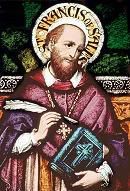
St. Francis de Sales, Bishop and Doctor Pictures, Images and Photos

When St. Francis de Sales was a young priest, he traveled to the Chablais region in France. Located south of Geneva, it had a population of around 72,000 people, most of whom had converted to Calvinism. St. Francis had a difficult time finding people who were willing to listen to him, so he began printing up pamphlets defending the Catholic faith. He put some up on placards on the streets, but most he slid under doors in the dark of the night. At the end of four years, he left the region almost entirely re-converted back to Catholicism.


I read his collected pamphlets collected in a book called The Catholic Controversy, published by Tan books. I remembered that he had written about one of the topics in our previous comment thread, and I am reproducing that chapter here in its entirety.

Resolution of a Difficulty

But a great proof of the contrary, as our adversaries think, is that, according to S. Paul: No one can lay another foundation but that which is laid: which is Christ Jesus; and according to the same we are domestics of God; built upon the foundation of the Apostles and Prophets, Jesus himself being the chief cornerstone. And in the Apocalypse [Revelation], the wall of the holy city had twelve foundations, and in these twelve foundations the names of the twelve Apostles. If then, say they, all the twelve Apostles are foundations of the Church, how do you attribute this title to S. Peter in particular? And if S. Paul says that no one can lay another foundation than Our Lord, how do you dare to say that by these words: Thou art Peter, and on this rock I will build my church, S. Peter had been established as foundation of the Church? Why do you not rather say, asks Calvin, that this stone on which the Church is founded is no other than Our Lord? Why do you not rather declare, says Luther, that it is the confession of faith which Peter had made?

But in good truth it is an ill way of interpreting Scripture to overturn one passage by another, or to strain it by a forced interpretation to a strange and unbecoming sense. We must leave to it as far as possible the naturalness and sweetness of the sense which belongs to it.

In this case, then, since we see that Scripture teaches us there is no other foundation than Our Lord, and the same teaches us clearly that S. Peter is such also, yea and further that the Apostles are so, we are not to give up the first teaching for the second, the second for the third, but to leave them all three in their entirety. Which we shall easily do if we consider these passages in good faith and sincerely.

Now Our Lord is in very deed the only foundation of the Church; he is the foundation of our faith, of our hope and charity; he is the foundation of all ecclesiastical authority and order, and of all the doctrine and administration which are therein. Who ever doubted of this? But, some one will say to me, if he is the only foundation, how do you place S. Peter also as foundation?

You do us wrong; it is not we who place him as foundation. He, besides whom no other can be placed, he himself placed him. So that if Our Lord is true founder of the Church, as he is, we must believe that S. Peter is such too, since Our Lord has placed him in this rank. If any one besides Our Lord himself had given him this grade we should all cry out with you: No one can lay another foundation but that which is laid.

And then, have you well considered the words of S. Paul? He will not have us recognize any foundation besides Our Lord, but neither is S. Peter nor are the other Apostles foundations besides Our Lord, they are subordinate to Our Lord: their doctrine is not other than that of their Master, but their very Master's itself Thus the supreme charge which S. Peter had in the militant Church, by reason of which he is called foundation of the Church, as chief and governor, is not beside the authority of his Master, but is only a participation in this, so that he is not the foundation of this hierarchy besides Our Lord but rather in Our Lord; as we call him most holy Father in Our Lord, outside whom he would be nothing.

We do not indeed recognize any other secular authority than that of His Highness [of Savoy], but we recognize several under this, which are not properly other than that of His Highness, because they are only certain portions and participations of it.

In a word, let us interpret S. Paul passage by passage: do you not think he makes his meaning clear enough when he says: You are built upon the foundations of the Prophets and Apostles? But that you may know these foundations to be no other than that which he has preached, he adds: Christ himself being the chief cornerstone. Our Lord then is foundation and S. Peter also, but with so notable a difference that in respect of the one the other may be said not to be it. For Our Lord is foundation and founder, foundation without other foundation, foundation of the natural, Mosaic and Evangelic Church, foundation perpetual and immortal, foundation of the militant and triumphant, foundation by his own nature, foundation of our faith, hope nad charity, and of the efficacy of the Sacraments.

S. Peter is foundation, not founder, of the whole Church; foundation but founded on another foundation, which Our Lord; foundation of the Evangelic Church alone, foundation subject to succession, foundation of the militant not of the triumphant, foundation by participation, ministerial not absolute foundation; in fine, administrator and not lord, and in no way the foundation of our faith, hope and charity, nor of the efficacy of the Sacraments. A difference so great as this makes the one unable, in comparison, to be called a foundation by the side of teh other, whilst, however, taken by itself, it can be called a foundation, in order to pay proper regard to the Holy Word. So, although he is the Good Shepherd, he gives us shepherds under himself, between whom and his Majesty there is so great a difference that he declares himself to be the only shepherd.

At the same time it is not good reasoning to say: all the Apostles in general are called foundations of the Church, therefore S. Peter is only such in the same way as the others are. On the contrary, as Our Lord has said in particular, and in particular terms, to S. Peter, what is afterwards said in general of the others, we must conclude that there is in S. Peter some particular property of foundation, and that his is in particular has been what the whole college has been together.

The whole Church has been founded on all the Apostles, and the whole on S. Peter in particular; it is then S. Peter who is its foundation taken by himself, which the others are not. For to whom has it ever been said: Thou art Peter, etc.? It would be to violate the Scripture to say that all the Apostles in general have not been the foundations of the Church. It would also be to violate the Scripture to deny that S. Peter was so in particular. It is necessary that the general word should produce its general effect, and the particular its particular, in order that nothing may remain useless and without mystery out of Scriptures so mysterious. We have only to see for what general reason all the Apostles are called foundations of the Church: namely, because it is they who by their preaching have planted the faith, and the Christian doctrine; in which if we are to give some prerogative to any one of the Apostles it will be to that one who said: I have laboured, more abundantly than all they.

And it is in this sense that is meant the passage of the Apocalypse [Revelation]. For the twelve Apostles are called foundations of the heavenly Jerusalem, because they were the first who converted the world to the Christian religion, which was as it were to lay the foundations of the glory of men, and the seeds of their happy immortality. But the passage of S. Paul seems to be understood not so much of the person of the Apostles as of their doctrine. For it is not said that we are built upon the Apostles, but upon the foundation of the Apostles--that is, upon the doctrine which they have announced.

This is easy to see, because it is not only said that we are upon the foundation of the Apostles, but also of the Prophets, and we know well that the Prophets have not otherwise been foundations of the Evangelical Church than by their doctrine. And in this matter all the Apostles seem to stand on a level, unless S. John and S. Paul go first for the excellence of their theology. It is then in this sense that all the Apostles are foundations of the Church; but in authority and government S. Peter precedes all the others as much as the head surpasses the members; for he has been appointed ordinary pastor and supreme head of teh Church, the others have been delegated pastors entrusted with as full power and authority over all the rest of the Church as S. Peter, except that S. Peter was the head of them all and their pastor as of all Christendom.

Thus they were foundations of the Church equally with him as to the conversion of souls and as to doctrine; but as to the authority of governing, they were so unequally, as S. Peter was the ordinary head not only of the rest of the whole Church but of the Apostles also. For Our Lord had built on him the whole of his Church, of which they were not only parts but the principal and noble parts.

"Although the strength of the Church," says S. Jerome, "is equally established on all the Apostles, yet amongst the twelve one is chosen that a head being appointed occasion of schism may be taken away." "There are, indeed," says S. Bernard to his Eugenius, and we can say as much of S. Peter for the same reason, "there are others who are custodians and pastors of flocks, but thou hast inherited a name as much the more glorious as it is more special."

AddThis Social Bookmark Button

The Primacy of Peter

A few weeks back, I said that I would put up a blog post with a Biblical argument for the primacy of Peter. We haven't covered this topic yet, so I thought it was time to check this one off of the list.

Peter is mentioned more than the other apostles. Actually, he is mentioned 155 times alone, whereas the other apostles are mentioned a combined 130 times.

When the apostles are named, Peter is almost always mentioned first. (Mark 1:36; 3:16; Luke 6:14-16; Acts 1:3)

Peter is the first to confess the divinity of Christ. (Matt. 16:16, Mark 8:29; John 6:69)

Only Peter walks on water. (Matt. 14:28-29)

Jesus says that Satan as sought the apostles, but He prays for Peter alone, that his faith not fail so that he could confirm his brethren. (Luke 22:31-32)

Only Peter's death is foretold by Jesus. (John 13:36; 21:18)

Only Peter is told that he has received a divine revelation. (Matt. 16:17)

The tax collector approaches Peter as the representative for Jesus to collect the temple tax. (Matt. 17:24-25)

Peter usually acts as spokesman for the apostles. (Matt. 18:21, Mark 10:28, Mark 11:21 among others)

Peter is the only one who speaks at the Transfiguration, and is again mentioned first going up the mountain. (Luke 9:28;33)

Only Peter is given the keys, the sign of authority. (Matt. 16:19)

Although John arrives at the tomb first, he waits to let Peter enter first. (Luke 24:12, John 20:4-6)

Peter is confirmed as leader of the apostles when the angel says that Jesus was resurrected. (Mark 16:7)

Jesus tells Peter to feed His sheep. (John 21:15-17)

Peter is the one who says that a successor to Judas must be chosen. (Acts 1:15)

Peter gives the first preaching (Acts 2:38) of the early Church, and also performs the first healing (Acts 3:6-7). Only Peter's shadow is mentioned as healing. (Acts 5:15)

Peter is shown exercising authority in the early Church. (Acts 5:3 and Acts 8:20-23)

When the first council of Jerusalem is held to debate the issue of circumcision for the gentile, there is much disputing, however, when Peter speaks, then the multitude is silent (Acts 15:12). Barnabas and Paul speak in support of what Peter has declared (Acts 15:12). Finally, James says that he agrees with Peter and provides Scriptural support for what Peter declared (Acts 15:13-14).

Paul visits Peter before beginning his ministry. (Gal.1:18)

Paul also mentions Peter as having seen Jesus first after his Resurrection. (1 Cor. 15:4-8)

Peter is the only apostle to have his name changed. St. Francis de Sales writes:

When Our Lord imposes a name upon men he always bestows some particular grace according to the name which he gives them. If he changes the name of that great father of believer, and of Abram makes him Abraham, also of a high father he makes him father of many, giving the reason at the same time (Gen 17:5) . . . The imposition of the name in the case of Saint Peter is no small argument of the particular excellence of his charge, according to the very reason which Our ¬ord appended: Thou art Peter, etc.

But What name does he give him? A name full of majesty, not common, not trivial, but one expressive of superiority and authority, like unto that of Abraham himself. For if Abraham was thus called because he was to be the father of many nations, Saint Peter has received this name because upon him as upon a firm rock was to be founded the multitude of Christians.

Our Lord himself is by excellence called the rock, because he is the foundation of the Church, and the corner-stone, the support, and the firmness, of this spiritual edifice: and he has declared that on Saint Peter should his Church be built, and that he would establish him in the faith: Confirm thy brethren. (Luke 22:32)

St. Frances de Sales has an excellent letter on Jesus versus Peter as the foundation of the church. Since that point was discussed extensively in a previous comments section, I am planning to type it up in its entirety and post it as a follow-up in the next day or two.

For other Pope related questions, see our previous post, Papal Ponderings.

AddThis Social Bookmark Button

Friday, October 9, 2009

A day in the life of the pope.pdf (application/pdf Object)

As Jennie has taken to pope bashing I thought it would be interesting to look at what a day in the life of the Pope really looks like and found this.

A day in the life of the pope.pdf (application/pdf Object)

Keeping in mind that the pope is over 80 years old, I thought this was actually a pretty active lifestyle for our beloved B16.

I also think it is good to remind some critics of the papacy how Pope's really live and lead Catholic Christians.


Add to Technorati Favorites


Please browse my eBay items!
Visit my new Amazon Store!

Tuesday, October 6, 2009

Once Saved, Always Saved

Today, Candy takes on the question of whether or not one can lose their salvation. She puts forth her position as thus:

There have been many people who claim that they used to be Christians, but have left the faith. I posit the likelihood that most of those people were never truly saved - that they never tasted of the heavenly gift, and were made partakers of the Holy Ghost. I think most of them played church, or played holy person for a while, but then they gave it up when it didn't work. That is not salvation, and praise God for that.

Candy says that her position is unusual, but it is the most common that I have heard. I really haven't run across many people who feel that you are always saved, no matter what you do, even if you reject the faith. I hear "then they must have never really been saved" a lot, especially relating to people who have converted to Catholicism.

In Candy's normal, sensitive way, she says that people who have forsaken the sake must be idiots. She gives the impression that people who have lost their faith are shallow and only "played church." I'm not sure how people who were so convinced of their faith as to become ministers could only be playing at church, but that is her belief.

I can't help but feel sorrow for people who had a deep faith, but lost it because of a tragedy in their lives, or persecution, or temptation to despair. Consider those who lost their families in a natural disaster such as the tsunami a few years back. When your children are literally ripped from your hands, who could help but to have at least some doubts about God.

We also discussed in the comments section just a week or so ago, the Donatists who were dealing with Christians who had renounced the faith under the Roman persecution. While Candy would say that someone who renounced the faith rather than be martyred was likely never saved in the first place, the Donatists felt that these people had lost the grace of God. Truly, the problem of what it means when someone rejects the faith is one which has always been around.

Personally, while I hope and pray that in a time of sorrow or persecution I would cling to God instead of reject him, I feel nothing but sorrow for those who have not been able to keep the faith. I can't imagine how horrible it must be to have been a joyful member of a OSAS congregation, and then have all of your friends and former fellow Christians reject you and say that you must have only been playing at church instead of reaching out to you in your time of need.

As for the Catholic Church, we believe that salvation is an ongoing process. As Milehimama once put it:

We HAVE BEEN saved by grace:
Who hath saved us, and called us with an holy calling, not according to our works, but according to his own purpose and grace, which was given us in Christ Jesus before the world began

We ARE BEING saved
1 Cor 1:18, above.
Even when we were dead in sins, hath quickened us together with Christ, (by grace ye are saved;)- Ephesians 2:5

We WILL BE saved:
And ye shall be hated of all men for my name's sake: but he that endureth to the end shall be saved - Matt 10:22

We HOPE to be saved:
For we are saved by hope: but hope that is seen is not hope: for what a man seeth, why doth he yet hope for? - Romans 8:24


One could write pages on the many verses which speak of this teaching, but I will share only a few which lead me to disagree with Candy on this subject.

Hope is one of the three theological virtues, faith, hope, and charity. We hope to be saved.

Rom 5:2 By whom also we have access by faith into this grace wherein we stand, and rejoice in hope of the glory of God.

Rom 12:12 Rejoicing in hope; patient in tribulation; continuing instant in prayer

Gal 5:5 For we through the Spirit wait for the hope of righteousness by faith.

1 Thes 5:8 But let us, who are of the day, be sober, putting on the breastplate of faith and love; and for an helmet, the hope of salvation.

Furthermore, perseverance is important. If we are "once saved, always saved" then why would we need to persevere. Merely playing at faith is not truly having faith, so perseverance is not needed there, only true faith.

Heb 3:13-14 But exhort one another daily, while it is called To day; lest any of you be hardened through the deceitfulness of sin. For we are made partakers of Christ, if we hold the beginning of our confidence stedfast unto the end

1 Tim 19-20 Holding faith, and a good conscience; which some having put away concerning faith have made shipwreck of whom is Hymenaeus and Alexander; whom I have delivered unto Satan, that they may learn not to blaspheme.

Heb 10:36 For ye have need of endurance, that, after ye have done the will of God, ye might receive the promise.

1 Cor 4:4 For I know nothing by myself; yet am I not hereby justified: but he that judgeth me is the Lord.

And one of my favorite verses in the Bible, 2 Tim 4:7 I have fought the good fight, I have finished
the race, I have kept the faith.


AddThis Social Bookmark Button