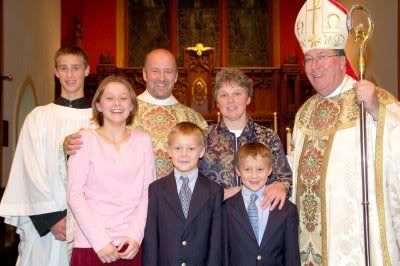
I first posted this article in 2007. In Candy's latest post on the role of women, she writes about marriage and singleness in the comments. I have interspersed her comments within the article.

Most people are well aware that in the Catholic Church, priests do not marry. (For the record, celibate means "unmarried" in Catholic terminology.)
However, many are unaware that this is not considered a matter of doctrine, but of tradition (with a little t). The Church finds this the best practice for now, but it could change. Although there were both married and celibate (unmarried) priests in the early centuries, the church adopted celibacy as the practice because it made certain things easier at the time, mostly due to inheritance issues. We keep it because we still find it convenient for other reasons.
Actually, there are already married priests within the church. In what is known as the Eastern Rites (think Orthodox, but in union with Rome) if men are married when they are ordained, they will be married priests. If they are unmarried when they are ordained, then they must remain so. Also, former Orthodox or Anglican priests who convert, can request to be priests in the Roman Rite. These men, such as
Dwight Longenecker, pictured above with his family, will also be married Catholic priests.
Protestants often point to this practice and say that it isn't Biblical. Some might point out the importance of marriage in the Old Testament. The figures of the Old Testament were very much concerned with building the Israelites as God's Chosen People. The New Testament is concerned with building the Kingdom of God.
Who is the central figure who precedes Jesus in the New Testament? John the Baptist, who appears to have been the first monk in the desert. There are many verses in the New Testament which point favorably to remaining unmarried:
Matt 19:12 For there are some eunuchs, which were so born from their mother's womb: and there are some eunuchs, which were made eunuchs of men: and there be eunuchs, which have made themselves eunuchs for the kingdom of heaven's sake. He that is able to receive it, let him receive it.
Matt 19:29 And every one that hath forsaken houses, or brethren, or sisters, or father, or mother, or wife, or children, or lands, for my name's sake, shall receive an hundredfold, and shall inherit everlasting life.
1 Cor 7:1Now concerning the things whereof ye wrote unto me: It is good for a man not to touch a woman.
And you might notice that Paul then goes on to say that everyone should marry, to avoid fornication.
Candy specifically points this out, saying "
1 Corinthians 7:1 is referring to the unmarried state. When a man is single, he is not to touch a woman - not to have sexual relations. This is why the next verse begins talking about avoiding fornication. When a man marries, then not only is he to touch his woman - he is commanded to "render due benevolence."
But the line after that is:
1 Cor 7:6 But I speak this by permission, and not of commandment.
7:7 For I would that all men were even as I myself.
He is giving permission for verses 2 though 5. It is not a commandment, because it is better to be as he is, himself. Further down, he writes:
1 Cor 7:27 Art thou bound unto a wife? seek not to be loosed. Art thou loosed from a wife? seek not a wife.
7:32 But I would have you without carefulness. He that is unmarried careth for the things that belong to the Lord, how he may please the Lord:
7:33 But he that is married careth for the things that are of the world, how he may please his wife.
One of the advantages for a celibate priest, is that he can devote himself full time to prayer and ministry, without caring for things of the world, and pleasing his wife.
1 Cor 7:38 So then he that giveth her in marriage doeth well; but he that giveth her not in marriage doeth better.
Candy writes, "
Paul cannot be saying that it's better for men to stay single, else he would be contradiction God, when God commanded us to "be fruitful and multiply." We cannot do that unless we marry.
If Paul meant that it is better for men to stay single, then he would also be contradicting himself, for Paul also said the following: "Now the Spirit speaketh expressly, that in the latter times some shall depart from the faith, giving heed to seducing spirits, and doctrines of devils; Speaking lies in hypocrisy; having their conscience seared with a hot iron; Forbidding to marry, and commanding to abstain from meats, which God hath created to be received with thanksgiving of them which believe and know the truth." -1 Timothy 4:1-3"
I think that the second paragraph is what is leading Candy's interpretation of Paul. She doesn't want to concede that Paul wrote favorably of celibacy, because it could be used to justify the Catholic celibate priesthood. However, the Catholic Church does not forbid anyone from marrying. Those who are ordained priests are usually (though not always, as I wrote above) chosen from single men, who choose to take a vow of celibacy. The
Shakers forbade marriage; the Catholic Church does not.
Candy adds further verses to prove her point:
Pastors/deacons/bishops (biblically, bishop and pastor are the same office, and deacons are likely elders in the church, BTW) are told to marry, as well: "A bishop then must be blameless, the husband of one wife, vigilant, sober, of good behaviour, given to hospitality, apt to teach" -1 Timothy 3:2 "Let the deacons be the husbands of one wife, ruling their children and their own houses well." -1 Timothy 3:12These verses are not commanding bishops and deacons to marry. It is saying that they should not be
polygamous. I wonder if Candy would infer that men who are married, but have not been able to have children should not be ordained deacons, since they cannot demonstrate "ruling their children" well.
I don't think that we need to stack the verses speaking favorably of marriage and those speaking favorably of celibacy and measure the two. I think that the New Testament makes it clear that there is now a new choice available. Now some will be called to give themselves entirely to God, and this is a valid choice.
If you look at the history of the Church, it is clear that from the very first years of the Church, people listened to the parable of the rich young man, and took it to apply to themselves. Young widows gathered together in a house and devoted themselves to prayer instead of marrying again. Young men sold all of their possessions and went to pray in the desert. This all happened immediately, not starting in the Middle Ages.
From my point of view, it is the protestant churches which do not allow a person to chose this as an option. If a young man who had graduated from seminary openly said that he had no intention of marrying because he wanted to devote himself to prayer and his work for the church, would he really be able to find a job? On the other hand, the Catholic church has a position of deacon, which is an ordained position available for married men.
Candy actually seems to agree with my position here, as she says "
It is great if a person can devote their whole life to God, and not desire a spouse. However, if one desires a spouse, they should not forbid to marry, but should in fact start their own family unit. The unmarried life, devoted completely to God are for those who don't have the desire to marry, and is never biblically forced on anyone."
Candy, who likes to read testimonies about women being held prisoner in convents, clearly views priests as being forced to remain single. They are forbidden from marrying. However, we do not see it that way.
Our seminary process is long, and with ample opportunity for the men to discern if this is truly their calling. I know someone who got married recently, who spent two years in a Catholic seminary. He discerned that he was not called to the priesthood after all. That is not looked down upon at all in our church, but on the other hand, an indication that the process works.
Priests are certainly not unhappy with the state of affairs.
"Job satisfaction is not a problem for U.S. priests, nearly 100 percent of whom either "strongly agree" or "somewhat agree" with the statement: "Overall, I am satisfied with my life as a priest." That was among the findings of the Center for Applied Research in the Apostolate, CARA, in a telephone poll of 1,212 priests released Sept. 9."
A 2007 University of Chicago job satisfaction survey found eighty-seven percent of clergy said they were "very satisfied" with their work. This was all clergy lumped together, which suggests that while protestant clergy are very satisfied with their jobs, that Catholic clergy might be a little happier.
So again, while this is a tradition of the church, there are verses that speak approvingly of celibacy, indicating that it is a Biblically based practice.
The Catholic church isn't the only church with this practice, either. The Orthodox churches ordain both married and unmarried men, but if they are unmarried when ordained, then they must remain so. Bishops are chosen only from the celibate priests.
Orthodox, Anglican, and Catholic churches all have a monastic traditions, as well, where monks and nun devote themselves full time to prayer.