Pages

Showing posts with label Priests and Nuns. Show all posts

Sunday, April 25, 2010

Catholic Sex Scandals, Part III

In part three of "Catholic Sex Scandals" I am addressing the "talk is cheap, when are they going to DO something about it" criticism.

Efforts To Combat Clergy Sexual Abuse Against Minors: A Chronology [USA]
U. S. Bishops Approve Charter to Protect Children and Young People
Restructured Committee on Sexual Abuse Announced
Sex Abuse Committee Releases Preliminary Survey Results
Mixed Commission Ends Work In Rome on Sexual Abuse Charter
Essential Norms for Diocesan/Eparchial Policies Dealing with Allegations of Sexual Abuse of Minors by Priests or Deacons
Guidelines for Implementation of Safe Environment Programs
Training Held on 'Essential Norms'; Vatican Official Took Part
The John Jay Study results [comprehensive study commissioned by the USCCB]
Vatican Report on U.S. Seminaries
Pope blasts Irish bishops, orders Vatican probe
Vatican urges psychological tests on future priests
Guidelines for the use of psychology in the admission and formation of candidates for the priesthood
After an Accusation, Here is What Happens at the Vatican
A Papal Conversion [Article on changing procedures under Cardinal Benedict]
Vatican Publishes Procedures for Sex Abuse Cases
Vatican shows new transparency with online guide


AddThis Social Bookmark Button

Catholic Sex Scandals, Part II

My first entry on this topic concerned the common idea that the root cause of the Catholic sexual abuse problem is celibacy. This entry is to focus on "Why is it so hard for the church and church members to acknowledge the guilt of the priests and repudiate them?"

Pope apologizes to Irish abuse victims, orders Vatican investigation
Irish bishops apologize for 'depravity of abuse' described in Dublin
Catholic Order Apologizes to Abuse Victims
Catholic Bishops Apologize for Sex Abuse
German Bishops Apologize to Child Sex Abuse Victims
Chile's Catholic Church Apologizes for Child Abuse
Swiss bishops apologize, saying they underestimated abuse problem

Catholic bishops deliver full apology for child sex abuse [England and Wales]
U.S. Bishops Apologize for Scandal
Pope Meets Maltese Abuse Victims
Pope Meets With Victims of Sex Abuse By Clergy, Apologizes [USA]
Australia: Pope apologizes for church's sex crimes [bishops]
Pope says sorry to Australian victims of clerical sex abuse
Pope's brother apologizes to abuse victims at his former school
Paedophile priests must own up to their sins, says Vatican [Cardinal Bertone]
Papal preacher apologizes for anti-Semitic remarks

So, how much apologizing is enough? I know, the next remark is "Well, they aren't sincere. They're just apologizing because they got caught." Unfortunately, there is no way to prove sincerity. But to anyone asking the Catholic Church to acknowledge that there is a problem, you got it.


AddThis Social Bookmark Button


Saturday, April 24, 2010

Catholic Sex Scandals

With the new deluge of news articles about the sex scandals in the Catholic Church, I thought it would be important for me to put forth some resources for putting this in perspective.

First, there are not new cases being reported every day. The news articles which are being written are about cases which happened several decades previously.

Second, it is easy to point the finger at the Catholic rule of celibacy for clergy. If this were the case, then there wouldn't be any cases in other churches. However, this is not true at all. Abusers often take positions of authority, and a clergy member has a lot of respect and trust.
You can find cases of abuse in almost all denominations.

Lutheran
Presbyterian
Baptist
Methodist
Pentecostal
Episcopalian

Some question when other churches are going to institute similar policies as the Catholic Church for handling abuse. How soon policies have been adopted vary by denomination.

Most of the abuse in the Catholic cases tended to be of teenage males, which is not actually pedophilia, although most people think of the abuse as being of small children. Most pedophiles are married, not single.

In fact, Catholic priests are no more likely to be abusers than those of other denominations. What about other professions? Several studies have found the rate of abuse by teachers are much higher than that of clergy.

This article from Psychology Today reaffirms the same points that I wanted to make.


AddThis Social Bookmark Button


Saturday, December 12, 2009

Is Priestly Celibacy Biblical?

Photo Sharing and Video Hosting at Photobucket

I first posted this article in 2007. In Candy's latest post on the role of women, she writes about marriage and singleness in the comments. I have interspersed her comments within the article.


Most people are well aware that in the Catholic Church, priests do not marry. (For the record, celibate means "unmarried" in Catholic terminology.)

However, many are unaware that this is not considered a matter of doctrine, but of tradition (with a little t). The Church finds this the best practice for now, but it could change. Although there were both married and celibate (unmarried) priests in the early centuries, the church adopted celibacy as the practice because it made certain things easier at the time, mostly due to inheritance issues. We keep it because we still find it convenient for other reasons.

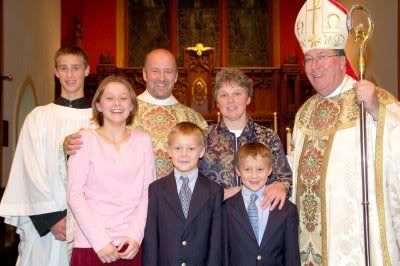
Actually, there are already married priests within the church. In what is known as the Eastern Rites (think Orthodox, but in union with Rome) if men are married when they are ordained, they will be married priests. If they are unmarried when they are ordained, then they must remain so. Also, former Orthodox or Anglican priests who convert, can request to be priests in the Roman Rite. These men, such as Dwight Longenecker, pictured above with his family, will also be married Catholic priests.

Protestants often point to this practice and say that it isn't Biblical. Some might point out the importance of marriage in the Old Testament. The figures of the Old Testament were very much concerned with building the Israelites as God's Chosen People. The New Testament is concerned with building the Kingdom of God.

Who is the central figure who precedes Jesus in the New Testament? John the Baptist, who appears to have been the first monk in the desert. There are many verses in the New Testament which point favorably to remaining unmarried:

Matt 19:12 For there are some eunuchs, which were so born from their mother's womb: and there are some eunuchs, which were made eunuchs of men: and there be eunuchs, which have made themselves eunuchs for the kingdom of heaven's sake. He that is able to receive it, let him receive it.

Matt 19:29 And every one that hath forsaken houses, or brethren, or sisters, or father, or mother, or wife, or children, or lands, for my name's sake, shall receive an hundredfold, and shall inherit everlasting life.

1 Cor 7:1Now concerning the things whereof ye wrote unto me: It is good for a man not to touch a woman.

And you might notice that Paul then goes on to say that everyone should marry, to avoid fornication.

Candy specifically points this out, saying "1 Corinthians 7:1 is referring to the unmarried state. When a man is single, he is not to touch a woman - not to have sexual relations. This is why the next verse begins talking about avoiding fornication. When a man marries, then not only is he to touch his woman - he is commanded to "render due benevolence."

But the line after that is:

1 Cor 7:6 But I speak this by permission, and not of commandment.

7:7 For I would that all men were even as I myself.

He is giving permission for verses 2 though 5. It is not a commandment, because it is better to be as he is, himself. Further down, he writes:

1 Cor 7:27 Art thou bound unto a wife? seek not to be loosed. Art thou loosed from a wife? seek not a wife.

7:32 But I would have you without carefulness. He that is unmarried careth for the things that belong to the Lord, how he may please the Lord:

7:33 But he that is married careth for the things that are of the world, how he may please his wife.

One of the advantages for a celibate priest, is that he can devote himself full time to prayer and ministry, without caring for things of the world, and pleasing his wife.

1 Cor 7:38 So then he that giveth her in marriage doeth well; but he that giveth her not in marriage doeth better.

Candy writes, "Paul cannot be saying that it's better for men to stay single, else he would be contradiction God, when God commanded us to "be fruitful and multiply." We cannot do that unless we marry.

If Paul meant that it is better for men to stay single, then he would also be contradicting himself, for Paul also said the following:


"Now the Spirit speaketh expressly, that in the latter times some shall depart from the faith, giving heed to seducing spirits, and doctrines of devils; Speaking lies in hypocrisy; having their conscience seared with a hot iron; Forbidding to marry, and commanding to abstain from meats, which God hath created to be received with thanksgiving of them which believe and know the truth." -1 Timothy 4:1-3"

I think that the second paragraph is what is leading Candy's interpretation of Paul. She doesn't want to concede that Paul wrote favorably of celibacy, because it could be used to justify the Catholic celibate priesthood. However, the Catholic Church does not forbid anyone from marrying. Those who are ordained priests are usually (though not always, as I wrote above) chosen from single men, who choose to take a vow of celibacy. The Shakers forbade marriage; the Catholic Church does not.

Candy adds further verses to prove her point: Pastors/deacons/bishops (biblically, bishop and pastor are the same office, and deacons are likely elders in the church, BTW) are told to
marry, as well:

"A bishop then must be blameless, the husband of one wife, vigilant,
sober, of good behaviour, given to hospitality, apt to teach" -1
Timothy 3:2

"Let the deacons be the husbands of one wife, ruling their children
and their own houses well." -1 Timothy 3:12

These verses are not commanding bishops and deacons to marry. It is saying that they should not be polygamous. I wonder if Candy would infer that men who are married, but have not been able to have children should not be ordained deacons, since they cannot demonstrate "ruling their children" well.

I don't think that we need to stack the verses speaking favorably of marriage and those speaking favorably of celibacy and measure the two. I think that the New Testament makes it clear that there is now a new choice available. Now some will be called to give themselves entirely to God, and this is a valid choice.

If you look at the history of the Church, it is clear that from the very first years of the Church, people listened to the parable of the rich young man, and took it to apply to themselves. Young widows gathered together in a house and devoted themselves to prayer instead of marrying again. Young men sold all of their possessions and went to pray in the desert. This all happened immediately, not starting in the Middle Ages.

From my point of view, it is the protestant churches which do not allow a person to chose this as an option. If a young man who had graduated from seminary openly said that he had no intention of marrying because he wanted to devote himself to prayer and his work for the church, would he really be able to find a job? On the other hand, the Catholic church has a position of deacon, which is an ordained position available for married men.

Candy actually seems to agree with my position here, as she says "It is great if a person can devote their whole life to God, and not desire a spouse. However, if one desires a spouse, they should not forbid to marry, but should in fact start their own family unit. The unmarried life, devoted completely to God are for those who don't have the desire to marry, and is never biblically forced on anyone."

Candy, who likes to read testimonies about women being held prisoner in convents, clearly views priests as being forced to remain single. They are forbidden from marrying. However, we do not see it that way.

Our seminary process is long, and with ample opportunity for the men to discern if this is truly their calling. I know someone who got married recently, who spent two years in a Catholic seminary. He discerned that he was not called to the priesthood after all. That is not looked down upon at all in our church, but on the other hand, an indication that the process works.

Priests are certainly not unhappy with the state of affairs.

"Job satisfaction is not a problem for U.S. priests, nearly 100 percent of whom either "strongly agree" or "somewhat agree" with the statement: "Overall, I am satisfied with my life as a priest." That was among the findings of the Center for Applied Research in the Apostolate, CARA, in a telephone poll of 1,212 priests released Sept. 9."

A 2007 University of Chicago job satisfaction survey found eighty-seven percent of clergy said they were "very satisfied" with their work. This was all clergy lumped together, which suggests that while protestant clergy are very satisfied with their jobs, that Catholic clergy might be a little happier.

So again, while this is a tradition of the church, there are verses that speak approvingly of celibacy, indicating that it is a Biblically based practice.

The Catholic church isn't the only church with this practice, either. The Orthodox churches ordain both married and unmarried men, but if they are unmarried when ordained, then they must remain so. Bishops are chosen only from the celibate priests.

Orthodox, Anglican, and Catholic churches all have a monastic traditions, as well, where monks and nun devote themselves full time to prayer.


AddThis Social Bookmark Button

Sunday, October 25, 2009

Apostolic Succession

Before we begin on the issue of apostolic succession, we first must discuss the nature of the priesthood. Some Christian churches do not believe in any sort of ordination. They feel that because of the priesthood of all believers, any member of the church may preach and lead their assembly. Others do practice a laying on of hands for ordination, seeing it as a symbolic act, similar to baptism.

For Catholics, ordination is a sacrament. Through ordination, a man becomes a priest, his priesthood indelibly imprinted on his soul, forever. Although many Christians feel that the priesthood ended with Christ, Catholics see the Levitical priesthood as a prefiguring of the ordained ministry of the New Covenant. As the Catholic Catechism explains:

1544 Everything that the priesthood of the Old Covenant prefigured finds its fulfillment in Christ Jesus, the "one mediator between God and men." The Christian tradition considers Melchizedek, "priest of God Most High," as a prefiguration of the priesthood of Christ, the unique "high priest after the order of Melchizedek"; "holy, blameless, unstained," "by a single offering he has perfected for all time those who are sanctified," that is, by the unique sacrifice of the cross.

1545 The redemptive sacrifice of Christ is unique, accomplished once for all; yet it is made present in the Eucharistic sacrifice of the Church. The same is true of the one priesthood of Christ; it is made present through the ministerial priesthood without diminishing the uniqueness of Christ's priesthood: "Only Christ is the true priest, the others being only his ministers."

This is important to note in the face of the accusation that Catholic priests are usurping the place Christ, who is our only true priest.

The Catholic Church does recognize the priesthood of all believers, or baptismal priesthood. The role of the ordained priesthood is to serve the rest of us, through dispensing the sacraments.

1120 The ordained ministry or ministerial priesthood is at the service of the baptismal priesthood. The ordained priesthood guarantees that it really is Christ who acts in the sacraments through the Holy Spirit for the Church. The saving mission entrusted by the Father to his incarnate Son was committed to the apostles and through them to their successors: they receive the Spirit of Jesus to act in his name and in his person. The ordained minister is the sacramental bond that ties the liturgical action to what the apostles said and did and, through them, to the words and actions of Christ, the source and foundation of the sacraments.

But how does the ordained priesthood have the authority to marry people, to forgive sins, etc? They were given this authority by Jesus, as it was passed down through the apostles.


And Moses said, Hereby ye shall know that the LORD hath sent me to do all these works; for I have not done them of mine own mind. Num 16:28

God gives Moses the authority to perform works on his behalf.

I can of mine own self do nothing: as I hear, I judge: and my judgment is just; because I seek not mine own will, but the will of the Father which hath sent me. John 5:30

In the same way, Jesus, as a man, acts under the authority of the Father.

And I appoint unto you a kingdom, as my Father hath appointed unto me Luke 22:29
Then he called his twelve disciples together, and gave them power and authority over all devils, and to cure diseases. Luke 9:1

Jesus gives this authority to his disciples.

And with that he breathed on them and said, "Receive the Holy Spirit." John 20:22

God imparted life to Adam through breathing on him. Therefore, this breathing was not just a symbol, but a sacrament. An outward sign of an inward grace which they received. This is something which they knew would be passed on to those who would come after them.

Acts 1:20-26 For it is written in the book of Psalms, Let his habitation be desolate, and let no man dwell therein: and his bishoprick let another take. Wherefore of these men which have companied with us all the time that the Lord Jesus went in and out among us, Beginning from the baptism of John, unto that same day that he was taken up from us, must one be ordained to be a witness with us of his resurrection. And they appointed two, Joseph called Barsabas, who was surnamed Justus, and Matthias. And they prayed, and said, Thou, Lord, which knowest the hearts of all men, shew whether of these two thou hast chosen, That he may take part of this ministry and apostleship, from which Judas by transgression fell, that he might go to his own place. And they gave forth their lots; and the lot fell upon Matthias; and he was numbered with the eleven apostles.

As this article from This Rock explains, "Peter considers Judas’s betrayal as a fulfillment of Old Testament prediction. And he also quotes from the Greek Septuagint translation of Psalm 109:8 (Psalm 108:8 in the Septuagint numbering) to show that filling the office was foreseen in Scripture. Verse 20 reads, "His office let another take." The word translated "office" is episkope, which in New Testament language means "episcopal office" (see 1 Tim. 3:1)."

Acts 9:7 shows that even Paul was ordained before he begins his ministry. And Ananias went his way, and entered into the house; and putting his hands on him said, Brother Saul, the Lord, even Jesus, that appeared unto thee in the way as thou camest, hath sent me, that thou mightest receive thy sight, and be filled with the Holy Ghost. Paul sees this ministry being passed down through the generations, "And the things that thou hast heard of me among many witnesses, the same commit thou to faithful men, who shall be able to teach others also." (2 Tim. 2:2).

So, the apostles received this authority from Jesus, which they passed down to their successors, which they passed down through the generations, and which we still recognize today, as do a few other churches. The Catechism explains it in this way:

1562 "Christ, whom the Father hallowed and sent into the world, has, through his apostles, made their successors, the bishops namely, sharers in his consecration and mission; and these, in their turn, duly entrusted in varying degrees various members of the Church with the office of their ministry." "The function of the bishops' ministry was handed over in a subordinate degree to priests so that they might be appointed in the order of the priesthood and be co-workers of the episcopal order for the proper fulfillment of the apostolic mission that had been entrusted to it by Christ."

1563 "Because it is joined with the episcopal order the office of priests shares in the authority by which Christ himself builds up and sanctifies and rules his Body. Hence the priesthood of priests, while presupposing the sacraments of initiation, is nevertheless conferred by its own particular sacrament. Through that sacrament priests by the anointing of the Holy Spirit are signed with a special character and so are configured to Christ the priest in such a way that they are able to act in the person of Christ the head."

1564 "Whilst not having the supreme degree of the pontifical office, and notwithstanding the fact that they depend on the bishops in the exercise of their own proper power, the priests are for all that associated with them by reason of their sacerdotal dignity; and in virtue of the sacrament of Holy Orders, after the image of Christ, the supreme and eternal priest, they are consecrated in order to preach the Gospel and shepherd the faithful as well as to celebrate divine worship as true priests of the New Testament."

1565 Through the sacrament of Holy Orders priests share in the universal dimensions of the mission that Christ entrusted to the apostles. The spiritual gift they have received in ordination prepares them, not for a limited and restricted mission, "but for the fullest, in fact the universal mission of salvation 'to the end of the earth," "prepared in spirit to preach the Gospel everywhere."

1566 "It is in the Eucharistic cult or in the Eucharistic assembly of the faithful (synaxis) that they exercise in a supreme degree their sacred office; there, acting in the person of Christ and proclaiming his mystery, they unite the votive offerings of the faithful to the sacrifice of Christ their head, and in the sacrifice of the Mass they make present again and apply, until the coming of the Lord, the unique sacrifice of the New Testament, that namely of Christ offering himself once for all a spotless victim to the Father." From this unique sacrifice their whole priestly ministry draws its strength.

1567 "The priests, prudent cooperators of the episcopal college and its support and instrument, called to the service of the People of God, constitute, together with their bishop, a unique sacerdotal college (presbyterium) dedicated, it is, true to a variety of distinct duties. In each local assembly of the faithful they represent, in a certain sense, the bishop, with whom they are associated in all trust and generosity; in part they take upon themselves his duties and solicitude and in their daily toils discharge them." priests can exercise their ministry only in dependence on the bishop and in communion with him. The promise of obedience they make to the bishop at the moment of ordination and the kiss of peace from him at the end of the ordination liturgy mean that the bishop considers them his co-workers, his sons, his brothers and his friends, and that they in return owe him love and obedience.

1568 "All priests, who are constituted in the order of priesthood by the sacrament of Order, are bound together by an intimate sacramental brotherhood, but in a special way they form one priestly body in the diocese to which they are attached under their own bishop. . . ." The unity of the presbyterium finds liturgical expression in the custom of the presbyters' imposing hands, after the bishop, during the rite of ordination.


Our records of the early church attest to their belief in apostolic succession.

"Through countryside and city [the apostles] preached, and they appointed their earliest converts, testing them by the Spirit, to be the bishops and deacons of future believers. Nor was this a novelty, for bishops and deacons had been written about a long time earlier.... Our apostles knew through our Lord Jesus Christ that there would be strife for the office of bishop. For this reason, therefore, having received perfect foreknowledge, they appointed those who have already been mentioned and afterwards added the further provision that, if they should die, other approved men should succeed to their ministry." (Clement of Rome, Epistle to the Corinthians 42:4-5, 44:1-3 [A.D. 80]).

"Polycarp also was not only instructed by apostles, and conversed with many who had seen Christ, but was also, by apostles in Asia, appointed bishop of the church in Smyrna, whom I also saw in my early youth, for he tarried [on earth] a very long time, and, when a very old man, gloriously and most nobly suffering martyrdom, departed this life, having always taught the things which he had learned from the apostles, and which the Church has handed down, and which alone are true. To these things all the Asiatic churches testify, as do also those men who have succeeded Polycarp down to the present time" (Irenaeus, Against Heresies 3:3:4). A.D. 189]

"[I]t is incumbent to obey the presbyters who are in the Church—those who, as I have shown, possess the succession from the apostles; those who, together with the succession of the episcopate, have received the infallible charism of truth, according to the good pleasure of the Father. But [it is also incumbent] to hold in suspicion others who depart from the primitive succession, and assemble themselves together in any place whatsoever, either as heretics of perverse minds, or as schismatics puffed up and self-pleasing, or again as hypocrites, acting thus for the sake of lucre and vainglory. For all these have fallen from the truth" (Irenaeus, Against Heresies, 4:26:2).

"But if there be any [heresies] which are bold enough to plant [their origin] in the midst of the apostolic age, that they may thereby seem to have been handed down by the apostles, because they existed in the time of the apostles, we can say: Let them produce the original records of their churches; let them unfold the roll of their bishops, running down in due succession from the beginning in such a manner that [their first] bishop shall be able to show for his ordainer and predecessor some one of the apostles or of apostolic men—a man, moreover, who continued steadfast with the apostles. For this is the manner in which the apostolic churches transmit their registers: as the church of Smyrna, which records that Polycarp was placed therein by John; as also the church of Rome, which makes Clement to have been ordained in like manner by Peter" (Tertullian Demurrer Against the Heretics 32 [A.D. 200].


AddThis Social Bookmark Button

Saturday, August 1, 2009

Secular clothing

I was sorry to hear that Candy was sick today. It's a shame to miss out on nice summer weather because you're sick.

Candy wrote: I am not dressed lady-like today. My legs are cold, so I'm wearing pants and a t-shirt. This is as secular looking as I get.

We have written here before about how the meaning of words change over time, and that it is especially important to define your terms when relating to Catholicism, because of a vocabulary which has been set for centuries.

I thought Candy's use of "secular" here was a bit humorous, given the root of the word.

I assume that Candy meant " not overtly or specifically religious."

I thought that her dresses were chosen mostly for modesty, but she has mentioned previously that she likes being immediately identifiable as a Christian. Which always makes me wonder why Christian men are allowed to go incognito. Couldn't they wear robes?

Anyway, the Catholic meaning of secular is not bound by monastic vows or rules ; specifically : of, relating to, or forming clergy not belonging to a religious order or congregation.

In the Middle Ages, churches were part of monasteries. However, at a certain point, priests began leaving the monasteries to tend to the "secular" people outside the monasteries. Today, there are priests who are part of a religious order, and secular priests, who are diocean priests.

Just a bit of trivia, for those interested.

AddThis Social Bookmark Button

Thursday, January 22, 2009

Sister Charlotte Collection

Elena has already posted an excellent rebuttal to the Sister Charlotte story. I thought I'd combine two other posts I wrote previously about Sister Charlotte.

Nun Revelations Revealed

When Sister Charlotte shared her testimony, she was following a template established years before. The scandalous tell-all began with a woman named Maria Monk. Maria wrote a book published in 1836, which told of her imprisonment, abuse. There was even the revelation that nuns had intercourse with priests and the resultant babies were baptized, killed, and buried in lime pits in the basement. Sound familiar?

Maria Monk's book was preceded by a similar book by Rebecca Reed, although her book is lesser known. Both books led to investigations, riots, and the burning of a convent. All investigations, tours of convents, etc., found absolutely no evidence that the stories were true. Maria Monk's own mother signed an affidavit denying that her daughter had ever been in a nunnery.

Just Another Urban Legend

Because Sister Charlotte never revealed her true identity or that of her convent, we have no proof that she ever was a nun. It is very possible that she was, as some of what she describes is true, such as the wearing of a wedding dress for the profession of vows. Regardless of how her tale began, she seems to have discovered that by embellishing it a bit, she could make for a more thrilling tale, and make her a more popular speaker among those who would be interested to hear tales of depravity from a Catholic convent.

Tales of the horrifying secret life of nuns are now something of an urban legend. Mary Crow Dog, in her book, Lakota Woman, repeats a similar story. She attended a reservation convent boarding school, and says that "everyone" knew that the nuns were hypocrites because, and then repeated the "priest + nun=dead babies" story. Only her version involved a sewer instead of a lime pit.

Urban legends are good stories. They start out in a very believable way.

First of all I always like to tell folk I’m not giving this testimony because I have any ill feeling in my heart toward the Roman Catholic people. I couldn’t be a Christian if I still had bitterness in my heart. God delivered me from all bitterness and strife and delivered me out of all of that one day and made himself real to me, and the power of the Holy Spirit.

Then, when you are caught up in the story, the more unbelievable elements are slipped into it. The average person listening isn't likely to know about the age you are able to enter a convent according to canon law, or the number of nuns allowed in a cloistered convent.

No, the best way to deal with any urban legend is to pepper to person telling the tale with questions, which poke holes in the story.

The priest will tell all over the whole United States and other countries that sisters, or nuns rather, can walk out of convents when they want to. I spent 22 years there. I did everything there was to do to get out. I’ve carried tablespoons with me into the dungeons and tried to dig down into that dirt, because there’s no floors in those places, but I’ve never yet found myself digging far enough to get out of a convent with a tablespoon and that’s about the only instrument.

So, the nuns are held prisoner and locked in the convents? Why did she even bother trying with a tablespoon? Did she really think she was going to dig a tunnel with a tablespoon? There are nun guards that will notice her digging with a spade, but they wouldn't notice a tunnel if it was dug by a tablespoon?

They can steal up to 40 dollars and they don’t have to tell the priest about it. They don’t have to say one word about it in the confessional box. They’re taught that. Every Roman Catholic knows it and every Roman Catholic (you’d be horrified if you know how many of them) steal up to that amount.

Why forty dollars? Is there any significance to the amount? Does is ever change for inflation? Is that $40 for your entire life, or just at any given time?

Later, she says: That's just a little idea or sample of what's going on in this country, and still there are thousands of mothers that will work their fingers to the bone to go over there and give the priest another five dollars to say a mass for loved one that is in purgatory, because that mother believes there is a purgatory.

Why do they have to work their fingers to the bone just to get five dollars? If you can steal up to forty dollars, then that's an easy way to get eight masses said, right? Or is there a rule that you have to earn money for purgatory masses?

I've had my front teeth knocked out.

I guess it's too late to ask Sister Charlotte to take out her bridge for us . . .

And most of the babies are premature. Many of them are abnormal. Very, very seldom do we ever see a normal baby.

Prematurity would certainly be consistent with starvation conditions. But why would they rarely have normal babies? These are healthy girls, with alcoholic but presumably healthy priests. Why would they have a higher than average incidence of birth defects?

You say, "Sister Charlotte, do you dare to say that?" I most definitely do dare to say it, and I intend to keep on saying it. Why? I've delivered those babies with these hands, and what I've seen with my eyes and I've done with my hands, I just challenge the whole world to say it isn't true. And the only way they can ever prove it isn't true, they'll have to open every convent door. If they ever serve a summons on me and call me into court, I'll assure you this one thing: convents are coming open and then the world will know what convents really are. And they'll have to open them to vindicate my testimony, because I know what I'll do if they ever serve a summons on me.

I think this is the crux of the whole story, here. Why didn't she go to the police? She says she's ready to testify in court. If she has traveled around, telling people this story, why didn't any of them demand an investigation as well? She's content to pray that the "little girls" escape the convent, but not actually do anything about it?

And almost equally ridiculous is the story of her escape.

And when something touched the garbage can that's a noise. Who in the world-? There's six of us and we're all together. Who is touching the garbage can? I wheeled around. They wheeled around, and we saw a man, and you know, that man was picking up the full can and leaving an empty one. I've never seen that before. I've been in that convent for years, and in the kitchen, but I never saw anything like that happen.

Okay, let me get this straight. They live in a cloistered convent. They never see anyone but priests. But the garbage man has a key, and walks into the kitchen to get the trash. Wow. How convenient for her. But I think if they were really serious about keeping the nuns prisoner, they would have at least left the trash outside the gate.

And I realized I'm on the outside. "Where am I going?" Where do you think you'd go? I'm not in the United States. I'm in another country and I don't know a thing about that country. When they took me over there I was so heavily veiled and they took me from that particular train to the convent, I was so heavily veiled I couldn't see anything.

Wait, how did she get in this other country? She said they took her a thousand miles away. How many other countries are there a thousand miles from any point in the United States? She would have either been in Canada or Mexico, right? And where did this heavy veil come from? She said she didn't get the white veil until after she had been at the convent for over a year. And since when do nuns wear veils over their faces?

Well, I've run out of time, but hopefully this gives you the general idea.

However, there is one last question to ask. If this is what is common in convent life, then why is it that The Truth Set Us Free: Twenty Former Nuns Tell Their Stories (as endorsed by Candy) contains absolutely nothing along the lines of Sister Charlotte's story?

AddThis Social Bookmark Button

Friday, January 9, 2009

Catholic Literacy

Jennie raised an interesting point in the comments section, and as we haven't had a new post in a bit, I thought I would explore it in a new post.

Jennie wrote:
my understanding is that, in general, protestants, or Bible-only christians, have, especially in the past, placed much more emphasis on memorizing and reading scripture than catholics have and therefore have placed more emphasis on teaching reading and scripture to their children and converts. . .

Catholics seem to have placed more value on songs and images to learn, and not on the written word, and not on preaching so much either. But God's word is the most important thing, whether you hear it or read it; it must be stressed and valued above all other teaching.

What I think when I read this is that you have an image of Middle Ages Catholicism here, as the Catholic model. Stained glass windows depicting Bible stories were certainly the norm of at that time, but that also predated the printing press.

Most of my non-Catholic friends send their children to Sunday School while they attend church services. There, their children sing songs and color pictures of Bible stories. My children sit through Mass with me. They listen to readings from the Bible, and recite prayers from Scripture. In this time period, the roles seem reversed to me.

Jennie then provides some examples:

By the mid-18th century, the ability to read and comprehend translated scripture led to Wales having one of the highest literacy rates. This was the result of a Griffith Jones's system of circulating schools, which aimed to enable everyone to read the Bible in Welsh. Similarly, at least half the population of 18th century New England was literate, perhaps as a consequence of the Puritan belief in the importance of Bible reading. . .

Interestingly, in 1893, a company of Vaudois migrated to the United States and founded the town of Valdeses, Burke County, North Carolina. At the time, a local newspaper wrote:

"All the little Waldensian children are taught to read and write at a very early age, and their knowledge of the scriptures would put to shame many of our church people of maturer years. They speak both French and Italian very fluently, and are all apparently very bright and intelligent and very anxious to learn the language of this new country."
(cited in a review of Wylies book History of the Waldenses, on Amazon.com)


Those are both around the same time period. Let me give some Catholic examples from that time period.

St. Katherine Drexel
In 1891, with a few companions, Mother Katharine founded the Sisters of the Blessed Sacrament for Indians and Colored People. The title of the community summed up the two great driving forces in her life—devotion to the Blessed Sacrament and love for the most deprived people in her country.

Requests for help reached Mother Katharine from various parts of the United States. During her lifetime, approximately 60 schools were opened by her congregation. The most famous foundation was made in 1915; it was Xavier University, New Orleans, the first such institution for Black people in the United States.

Sisters of Loretto
In 1811, Mary Rhodes came from Maryland to visit relatives and saw the lack of educational opportunities for pioneer children. Settling in Kentucky, Rhodes began teaching her own relatives basic skills and catechism. Soon neighbors asked her to teach their children, and as the number of pupils increased, Rhodes welcomed the assistance of Christina Stuart and Ann Havern. These three pioneer women, with Father Nerinckx as their spiritual guide, formed the Little Society of the Friends of Mary Under the Cross of Jesus in 1812.

After the Mexican War, the United States gained possession of the vast Southwest with a mostly Catholic population. In 1852, Bishop Jean Baptiste Lamy of Santa Fe requested the help of the Sisters of Loretto to work with the Spanish-speaking children of Santa Fe. Six sisters traveled by river boat to Independence, Missouri, and then followed the dangerous Missouri Trail 900 miles overland to Santa Fe. In Indian country, they came across others of their order who had been teaching Osage children in Kansas since 1847. One sister died of cholera on a river boat and another of exhaustion and terror after an Indian attack on their wagons.

In November 1852, they opened their first school, the Academy of Our Lady of the Light, an all-girls school in Santa Fe, which flourished until the late 1960s. Moving south to Las Cruces, the Sisters of Loretto founded Loretto Academy in 1870, another all-girls school offering classes in reading, spelling, algebra, modern and ancient geography, lace work and piano. This school played an integral part in the educational growth of the Mesilla Valley until it closed in June 1944.

St. Elizabeth Ann Seton

Elizabeth opened Saint Joseph's Free School February 22, 1810. It educated needy girls of the area and was the first free Catholic school for girls staffed by sisters in the country. Saint Joseph's Academy began May 14, 1810, with the addition of boarding pupils who paid tuition which enabled the Sisters of Charity to subsidize their charitable mission. Saint Joseph's Academy and Free School formed the cradle of Catholic education in the United States.

Mary Elizabeth Lange

It did not take Elizabeth long to recognize that the children of her fellow refugees needed an education. She responded to that need in spite of being a Black woman living in a slave state before the Emancipation Proclamation, where the education of slaves was against the law. She used her own money and home to teach Black children.

For ten years, Elizabeth and her friend Marie Magdaleine Balas, offered free education until, inevitably, finances became a problem. Providence intervened through the person of Reverend James Hector Joubert, S.S., who, with encouragement from Monsignor James Whitfield, Archbishop of Baltimore, challenged Elizabeth to establish a religious congregation for the education of Black children. Reverend Joubert would provide direction, solicit financial assistance, and encourage other "women of color" to become members of the first order of African American nuns in the history of the Catholic Church. On July 2, 1829, Elizabeth and three other women pronounced promises of obedience to the Archbishop of Baltimore.


I would also say that this Catholic literacy was not new to that time period. Consider the case of St. Francis de Sales.

Francis decided that he should lead an expedition to convert the 60,000 Calvinists back to Catholicism. But by the time he left his expedition consisted of himself and his cousin. His father refused to give him any aid for this crazy plan and the diocese was too poor to support him.

For three years, he trudged through the countryside, had doors slammed in his face and rocks thrown at him. In the bitter winters, his feet froze so badly they bled as he tramped through the snow. He slept in haylofts if he could, but once he slept in a tree to avoid wolves. He tied himself to a branch to keep from falling out and was so frozen the next morning he had to be cut down. And after three years, his cousin had left him alone and he had not made one convert.

Francis' unusual patience kept him working. No one would listen to him, no one would even open their door. So Francis found a way to get under the door. He wrote out his sermons, copied them by hand, and slipped them under the doors. This is the first record we have of religious tracts being used to communicate with people.

The parents wouldn't come to him out of fear. So Francis went to the children. When the parents saw how kind he was as he played with the children, they began to talk to him.

By the time, Francis left to go home he is said to have converted 40,000 people back to Catholicism.

Clearly, the people in this area had to be literate for tracts to have been effective. The tracts are in print today, and available as The Catholic Controversy, published by Tan books. I have a copy, and Francis is extremely familiar with Scripture, and makes almost all of his arguments based on Scripture.


AddThis Social Bookmark Button

Saturday, October 4, 2008

Catholic priests and celibacy

Roman Catholic priests/bishops, etc. are supposed to be celibate, and are forbidden to marry. Furthermore, RCs have certain days where they are not supposed to eat meat.

"A bishop then must be blameless, the husband of one wife, vigilant, sober, of good behaviour, given to hospitality, apt to teach;" -1 Timothy 3:2

Roman Catholic bishops are not allowed to marry, but the Bible commands that Christian bishops are supposed to marry.

October 4, 2008 KTH


The folks at Catholic Answers directly answer Candy's common attack.  I have some of the best excerpts below, but the entire article is a good read.  


Fundamentalists are often surprised to learn that even today celibacy is not the rule for all Catholic priests. In fact, for Eastern Rite Catholics, married priests are the norm, just as they are for Orthodox and Oriental Christians.

Even in the Eastern churches, though, there have always been some restrictions on marriage and ordination. Although married men may become priests, unmarried priests may not marry, and married priests, if widowed, may not remarry. Moreover, there is an ancient Eastern discipline of choosing bishops from the ranks of the celibate monks, so their bishops are all unmarried.

The tradition in the Western or Latin-Rite Church has been for priests as well as bishops to take vows of celibacy, a rule that has been firmly in place since the early Middle Ages. Even today, though, exceptions are made. For example, there are married Latin-Rite priests who are converts from Lutheranism and Episcopalianism.

As these variations and exceptions indicate, priestly celibacy is not an unchangeable dogma but a disciplinary rule. The fact that Peter was married is no more contrary to the Catholic faith than the fact that the pastor of the nearest Maronite Catholic church is married.


All of this is false. Although most people are at some point in their lives called to the married state, the vocation of celibacy is explicitly advocated—as well as practiced—by both Jesus and Paul.

So far from "commanding" marriage in 1 Corinthians 7, in that very chapter Paul actually endorses celibacy for those capable of it: "To the unmarried and the widows I say that it is well for them to remain single as I am. But if they cannot exercise self-control, they should marry. For it is better to marry than to be aflame with passion" (7:8-9).

It is only because of this "temptation to immorality" (7:2) that Paul gives the teaching about each man and woman having a spouse and giving each other their "conjugal rights" (7:3); he specifically clarifies, "I say this by way of concession, not of command. I wish that all were as I myself am. But each has his own special gift from God, one of one kind and one of another" (7:6-7, emphasis added).

Paul even goes on to make a case for preferring celibacy to marriage: "Are you free from a wife? Do not seek marriage. . . those who marry will have worldly troubles, and I would spare you that. . . . The unmarried man is anxious about the affairs of the Lord, how to please the Lord; but the married man is anxious about worldly affairs, how to please his wife, and his interests are divided. And the unmarried woman or girl is anxious about the affairs of the Lord, how to be holy in body and spirit; but the married woman is anxious about worldly affairs, how to please her husband" (7:27-34).

Paul’s conclusion: He who marries "does well; and he who refrains from marriage will do better" (7:38).

Paul was not the first apostle to conclude that celibacy is, in some sense, "better" than marriage. After Jesus’ teaching in Matthew 19 on divorce and remarriage, the disciples exclaimed, "If such is the case between a man and his wife, it is better not to marry" (Matt 19:10). This remark prompted Jesus’ teaching on the value of celibacy "for the sake of the kingdom":


"Not all can accept this word, but only those to whom it is granted. Some are incapable of marriage because they were born so; some, because they were made so by others; some, because they have renounced marriage for the sake of the kingdom of God. Whoever can accept this ought to accept it" (Matt. 19:11–12).


Celibacy is neither unnatural nor unbiblical. "Be fruitful and multiply" is not binding upon every individual; rather, it is a general precept for the human race. Otherwise, every unmarried man and woman of marrying age would be in a state of sin by remaining single, and Jesus and Paul would be guilty of advocating sin as well as committing it.


Another Fundamentalist argument, related to the last, is that marriage is mandatory for Church leaders. For Paul says a bishop must be "the husband of one wife," and "must manage his own household well, keeping his children submissive and respectful in every way; for if a man does not know how to manage his own household, how can he care for God’s Church?" (1 Tim. 3:2, 4–5). This means, they argue, that only a man who has demonstrably looked after a family is fit to care for God’s Church; an unmarried man, it is implied, is somehow untried or unproven.
This interpretation leads to obvious absurdities. For one, if "the husband of one wife" really meant that a bishop had to be married, then by the same logic "keeping his children submissive and respectful in every way" would mean that he had to have children. Childless husbands (or even fathers of only one child, since Paul uses the plural) would not qualify.

In fact, following this style of interpretation to its final absurdity, since Paul speaks of bishops meeting these requirements (not of their having met them, or of candidates for bishop meeting them), it would even follow that an ordained bishop whose wife or children died would become unqualified for ministry! Clearly such excessive literalism must be rejected.

The theory that Church leaders must be married also contradicts the obvious fact that Paul himself, an eminent Church leader, was single and happy to be so. Unless Paul was a hypocrite, he could hardly have imposed a requirement on bishops which he did not himself meet. Consider, too, the implications regarding Paul’s positive attitude toward celibacy in 1 Corinthians 7: the married have worldly anxieties and divided interests, yet only they are qualified to be bishops; whereas the unmarried have single-minded devotion to the Lord, yet are barred from ministry!

.


AddThis Social Bookmark Button

Monday, August 18, 2008

Speaking of Keralan Christians . . .

.- India will have its first saint on October 12 when Pope Benedict XVI canonizes Blessed Alfonsa of the Immaculate Conception, who is believed to have interceded in the miraculous cure of a child.

“One of the child’s legs was left motionless after a bomb exploded nearby and Alfonsa cured him. The exam by doctors confirmed it,” said Father Antony of the Syro-Malabar Catholic Church. He said the local church is elated, noting that she would be the first saint of India.

The full story includes a video.


AddThis Social Bookmark Button

Tuesday, July 29, 2008

One Final Mary Ann Collins Post

Candy writes: For those who've heard the gossipy rumors that Mary Ann Collins (the ex-nun who wrote the below article) does not exist, please know that what you've read/heard are nothing more than rumors. Mary Ann and I are in email contact - and I can attest that she is real, genuine, and truthful. God bless her heart for putting herself out there, in spreading the Gospel, in telling the truth, and in the sharing of her experiences.

This is a bit of a red herring. Clearly, someone is writing under the name of Mary Ann Collins, and so she does exist. He/She/They may be using a pseudonym, or that might really be her name. Maybe she was a novice at a convent for a while, and maybe she wasn't.

It really doesn't matter. You know why? Because the information in her writing is still wrong. As I've written before, just because a person used to be a priest or nun doesn't mean that that person is an accurate source of information about Catholicism.


AddThis Social Bookmark Button

Mary Ann Collins On Mary Worship, Part II

Picking up where I left off, I had some time to try and track down this accusation:

In 495 A.D., Pope Gelasius issued a decree which rejected this teaching as heresy and its proponents as heretics. In the sixth century, Pope Hormisdas also condemned as heretics those authors who taught the doctrine of the Assumption of Mary.

I checked several secular history sources, and none mention anything to do with this. The Nestorian controversy was going on at this time, but that was the only thing remotely related to Mary. Pope Gelasius is mostly referred to for setting the setting the Bible canon, which historians now think was a later Pope, for declaring Manicheans heretics for not taking communion under both kinds, and for combating another Eucharist-related heresy.

Pope Hormisdas gets even less mention in online encyclopedias than Pope Gelasius. Pope Hormisdas is reunited the Eastern and Western Church, after he convinced the Eastern Church to repudiate the heresy of Monophysitism. Monophysitism says that Jesus has only one nature, and that is his divine nature.

I think this Webster guy that she quotes so much is just making stuff up, and I'm not the only one.

The next section concerns parallels of Mary and Goddess worship.

Mary Ann Collins does not use The Two Babylons by Alexander Hislop as her source, but that is the original, completely discredited book which really started the Catholic=pagan argument. Many Bible Christians consider The Two Babylons as very authoritative on this sort of thing. Christians such as Ralph Woodrow, who has his own evangelistic association.

Mr. Woodrow found The Two Babylons so compelling, he wrote his own book about the pagan origins of Catholicism. But then, he started actually checking Hislop's citationsand they were not what they were purported to be. So Mr. Woodrow recanted his book, and wrote a different book called The Babylon Connection? debunking The Two Babylons.

The final section is How Did We Get Here:

The Early Fathers used Scripture as the standard against which they tested Church tradition. The modern Catholic doctrine that Church tradition is equal in authority with the Bible is contrary to the writings of the Early Fathers.

A survey of the Early Church Fathers does not support this.

She again cites Webster here, and this assertion of Webster was challenged in this article.

Notice the sleight of hand by Mr. Webster. He equates St. Irenaeus’s and Tertullian’s understanding of Tradition to mean Scripture. Both of these Fathers clearly understood Tradition as a substantive and coordinate authority alongside Scripture. These same Fathers believed that the doctrines of the Catholic Church are found in Tradition as well as in Scripture. However, they do not make the misguided conclusion that Tradition is equated to Scripture since Tradition includes the same doctrines that Scripture contains. The primary difference between Scripture and Tradition is that they convey the same teaching but through different mediums. One transmits the doctrines via the written Scriptures while Tradition transmits these same doctrines through the life, faith and practice of the Church. If Scripture is equated with Tradition than the writings of St. Irenaeus and Tertullian are reduced to nonsense.

The Pope is said to be infallible whenever he makes an official decree on matters of faith and morals. According to Catholic doctrine, it is impossible for the Pope to teach false doctrine. Catholics are expected to obey the Pope without question even when he is not making an “infallible” statement about doctrine. They are expected to submit their wills and minds to the Pope without question.

I covered Papal infallibility and other Pope issues here.

The history of the early Church shows that the Bishop of Rome was considered to be just another bishop. For example, Pope Gregory (590-604 A.D.) explicitly stated that all of the bishops were equal. He specifically repudiated the idea that any one bishop could be the supreme ruler of the Church.

No, that is not the case. Regarding Pope Gregory, Webster is again mentioned by name in this article.

In the seventeenth century, the Catholic church officially condemned Galileo as a heretic because he taught that the earth revolves around the sun. . .The “infallible” pronouncement of the Catholic Church regarding Galileo's teaching was wrong.

There was no infallible pronouncement about Galileo. For more information on the Galileo case, see this article.

There is a brief mention of Marian apparitions, however, she does not mention that Marian apparitions are considered private revelation, and are not required belief for any Catholic.

That concludes my survey of Mary Ann Collins lengthy article. If I didn't address something that you would like more information about, please leave a comment.

AddThis Social Bookmark Button

Mary Ann Collins On Mary Worship

Candy's current offering is a copy of an article by Mary Ann Collins.


Because the article is so extensive, I'm going to break it into sections, rather than go through the entire thing point by point.

Introduction:

We get reminded of Catholic abuses of power:
I always thought that abuses of power by the Catholic Church were something
that happened long ago.


See our article on Catholic Atrocities.

She mentions statues in churches: There were statues of Mary and the saints. They looked solid, real, as if they represented people of power.

I wrote about statues here, and Elena covers statues and crucifixes here.

There is a section on Devotion To Mary, which begins with pointing out the riches of the church: Vast sums of money are spent on jeweled crowns and lavish clothing for some special statues of Mary.

I wrote about the riches of the church here. I noticed that her source here is Dave Hunt, who is not a reliable source of information.

She brings up Mary as Mediatrix: De Liguori said that people should pray to Mary as
a mediator and look to her as an object of trust for answered prayer.
The book even says that there is no salvation outside of Mary.


See my Something About Mary post.

Next section: Catholic Doctrines about Mary

The doctrine of the Immaculate Conception was first introduced by a heretic
(a man whose teachings were officially declared to be contrary to Church
doctrine). For centuries this doctrine was unanimously rejected by popes,
Fathers and theologians of the Catholic Church. (Note 13)


ALL-HOLY -- Mary, "the All-Holy," lived a perfectly sinless
life. ("Catechism" 411, 493)

In contrast, Mary said that God is her Savior. (Luke 1:47) If God was
her Savior, then Mary was not sinless. Sinless people do not need a Savior.


Mary Ann gives a Catechism citation, but doesn't show what it says:

411 The Christian tradition sees in this passage an announcement of the "New Adam" who, because he "became obedient unto death, even death on a cross", makes amends superabundantly for the disobedience, of Adam. Furthermore many Fathers and Doctors of the Church have seen the woman announced in the Protoevangelium as Mary, the mother of Christ, the "new Eve". Mary benefited first of all and uniquely from Christ's victory over sin: she was preserved from all stain of original sin and by a special grace of God committed no sin of any kind during her whole earthly life.

493 The Fathers of the Eastern tradition call the Mother of God "the All-Holy" (Panagia), and celebrate her as "free from any stain of sin, as though fashioned by the Holy Spirit and formed as a new creature". By the grace of God Mary remained free of every personal sin her whole life long.

These paragraphs of the Catechism show that the Catholic Church teaches Mary DID need a Redeemer.

Catholic Answers explains it in this way:
Consider an analogy: Suppose a man falls into a deep pit, and someone reaches down to pull him out. The man has been "saved" from the pit. Now imagine a woman walking along, and she too is about to topple into the pit, but at the very moment that she is to fall in, someone holds her back and prevents her. She too has been saved from the pit, but in an even better way: She was not simply taken out of the pit, she was prevented from getting stained by the mud in the first place. This is the illustration Christians have used for a thousand years to explain how Mary was saved by Christ. By receiving Christ’s grace at her conception, she had his grace applied to her before she was able to become mired in original sin and its stain.

Matthew 1:24-25 says, "Then Joseph being raised from sleep did as the angel of the Lord had bidden him, and took unto him his wife: And knew her not till she had brought forth her firstborn son: and he called his name JESUS." "Till" (until) means that after that point,
Joseph did "know" (have sexual relations with) Mary. (See Genesis 4:1 where Adam "knew" Eve and she conceived and had a son.)

2 Sam 6:23 says that Michal had no child until the day she died. Does that mean that she bore children after her death? Until does not have the same connotation in the Bible as it does in modern English. It carries no implication of what happened after that time.

My Something About Mary covers these subjects, and this article contains links which show that these teachings were ACCEPTED, not rejected, for centuries by the Early Church Fathers, Popes, and theologians.

The Incarnation means that Jesus was both fully God and fully man. Mary
was only the mother of Jesus as man, and not the mother of Jesus as God.


I did an article on this just this week.

There is no biblical reference to the assumption of Mary.

If we are going by the criteria that "if it isn't mentioned in the Bible, it didn't happen", then I think you must also conclude that Mary is still alive, because her death isn't mentioned either.

The Bible contains everything we need to know in order to attain salvation. It does not claim to be an exhaustive compilation of all miracles which ever occurred, even just concerning Jesus.
John 21:25: And there are also many other things which Jesus did, the which, if they should be written every one, I suppose that even the world itself could not contain the books that should be written.

There is actually historic evidence, or lack of it, for the Assumption or Dormition of Mary; lack of a body. While the tomb of Mary has been a tourist attraction since the earliest centuries of the Church, the tomb is empty. No early accounts mention there every being a body in the tomb. Certainly, there is Biblical precedent for a person being assumed into heaven. As we keep talking about Mary as the Ark of the New Covenant, it would be fitting if her body is hidden, just as the Ark remains hidden.

The early Church clearly considered the doctrine of the Assumption of Mary to be a heresy worthy of condemnation.

I think the testimony of the early Church would disagree.

Okay folks, I'm out of time. Feel free to discuss in the comments, and I'll work on part two later.

AddThis Social Bookmark Button

Tuesday, March 18, 2008

Yes, I know

Yes, I know about that link to Richard Bennett's site, which Candy hid in her otherwise innocent post on the "emergent church cult."

The problem is, Richard Bennett is always really, really, wrong. And it takes time to write out a lengthly rebuttal of all that wrongness.

I mean, right on the first page of this three part article, he says "What McLaren never tells is that the authority of the Roman Papacy was not well established until near the end of the eleventh century, when by crusades and the Inquisition, the Papacy by coercion forced people to submit to her ecclesiastical dictates."

Pope Clement wrote in the 90's AD that The Church of God which sojourns in Rome to the Church of God which sojourns in Corinth....If anyone disobey the things which have been said by Him through us, let them know that they will involve themselves in transgression and in no small danger."

Pope Damascus wrote in the late 300's "Why then do you again ask me for the condemnation of Timotheus? Here, by the judgment of the apostolic see, in the presence of Peter, bishop of Alexandria, he was condemned, together with his teacher, Apollinarius, who will also in the day of judgment undergo due punishment and torment. But if he succeeds in persuading some less stable men, as though having some hope, after by his confession changing the true hope which is in Christ, with him shall likewise perish whoever of set purpose withstands the order of the Church. May God keep you sound, most honoured sons."

There are lots more examples, but clearly, the papacy was well-established before the eleventh century.

So, just take my word for it, Richard Bennett is not a reliable source of information. You can read previous posts about him on this blog here and here.

You can also read the full text of the document which Bennett quotes from here.


AddThis Social Bookmark Button

StumbleUpon Toolbar Stumble It!

Monday, February 25, 2008

Priestly Attire

I was reading Fr. Longenecker again, and he has written about why priests wear vestments. While his answer is really more of a commentary on bad liturgical vestments, he does get to the point of the matter.

If the Mass is the Royal Marriage Feast of the Lamb, then the priest should dress up for his entrance into the royal court. The robes should therefore be regal in their dignity, their simplicity and their style. As much as possible their beauty should be shown, not by cleverness of design or ornamentation, but through quality materials and fine workmanship.

Why should the priest dress like a king? Because he reminds the whole people of God that they serve Christ the King, and the priest is in persona Christi. Furthermore, they remind the people of God that they too are a chosen people, and a royal priesthood. The priest focuses in his own person and ministry the royal priesthood of the people of God. Furthermore, when the priest dresses in fine robes he symbolizes the riches of grace bestowed upon the people of God. Over the black cassock of his sinful human condition the priest wears the white alb--the symbol that he, (and his people) are clothed in the righteousness of Christ by virtue of their baptism. Over that he wears a splendid chasuble to show that the final state of the Christian is not just the white robes of Christ's righteousness, but a share in Christ's own royal priesthood. Each of the faithful are princes and princesses--adopted into the royal family.
It struck me that this is just the sort of topic that works well on this blog. Priestly vestments are one of those things that anti-Catholics like to bring up. Just read a little bit on Antichrist Truth and you will see that they quote Revelation 17:4 “the woman was arrayed in PURPLE and SCARLET colour, and decked with GOLD and precious stones and pearls, having a golden cup in her hand” as proof of the Catholic Church being the anti-Christ.

In fact, Jesus-Is-Savior points to Baptist ministers wearing liturgical robes as one of several points of ungodly influence of Catholicism on the Baptist churches.

Fr. Longenecker's explanation was great, but if it peaked your interest, here is further reading:
The History and Use of Vestments
Catholic Encyclopedia on Vestments


AddThis Social Bookmark Button

StumbleUpon Toolbar Stumble It!

Friday, February 1, 2008

Let's Study the Bible!


AddThis Social Bookmark Button

When I was a girl, John 1:1 was my favorite verse. An odd choice for a child, but I loved the sound of it, and the circle that it made. "In the beginning was the Word, and the Word was with God, and the Word was God."

Studying the Bible is always a good idea, and the first chapter of John is a great starting place. Some resources to start you on your journey, while heeding the admonition to "lean not on your own understanding." Pv. 3:5.

I thought a sample of the richness of the doctors of the Church might be in order.

St. John Chrystostom, Homilies on the Gospel of St. John
St. Augustine, Tractates on the Gospel of St. John
St. Thomas Aquinas, Commentary on the Gospel of St. John
Biblia Clerus' repository of commentary on the Gospel of St. John

John 1:29 says "The next day John seeth Jesus coming unto him, and saith, Behold the Lamb of God, which taketh away the sin of the world."

Candy's note on John 1:29: Jesus takes away the sins of anyone who will let Him. There is nothing else one must do to be saved. Jesus paid it all. Jesus is our perfect sacrificial Lamb, whose sacrifice pays for ALL of our sins. In the Old Testament, lambs and other animals had to be sacrificed on a regular basis, to atone for sins. God Himself, as Jesus Christ, became the perfect sacrificial Lamb, to pay for our sins.

The note to John 1:29 in my Navarre Bible Reader's Edition:

For the first time in the Gospel Christ is called the "Lamb of God". Isaiah had compared the sufferings of the Servant of Yahweh, the Messiah, with the sacrifice of a lamb (cf. Is 53:7); and the blood of the paschal lamb smeared on the doors of houses had served to protect the first-born of the Israelites in Egypt (cf. Ex 12:6-7): all this was a promise and prefiguring of the true Lamb, Christ, the victim in the sacrifice of Calvary on behalf of all mankind. This is why St. Paul will say that "Christ, our paschal lamb, has been sacrificed" (1 Cor 5:7). The expression "Lamb of God" also suggests the spotless innocence of the Redeemer (cf. 1 Pet 1:18-20; 1 Jn 3:5).

The sacred text says "the sin of the world", in the singular, to make it absolutely clear that every kind of sin is taken away: Christ came to free us from original sin, which in Adam affected all men, and from all personal sins.

The book of Revelation reveals to us that Jesus is victorious and glorious in heaven as the slain lamb (cf. Rev 5:6-14), surrounded by saints, martyrs and virgins (Rev 7:9, 14; 14:1-5), who render him the praise and glory due him as God (Rev 7:10). Since Holy Communion is a sharing in the sacrifice of Christ, priests say these words of the Baptist before administering it, to encourage the faithful to be grateful to our Lord for giving himself up to death to sve us and for giving himself to us as nourishment for our souls.

StumbleUpon Toolbar Stumble It!