
Sunday, October 28, 2012

Thursday, January 26, 2012
Why I am Catholic
The Why I AM Catholic Blog has testimonies of people from all denominations who have converted to Catholicism. This one by Katie Plato has a lot of similarities to Candy.
Friday, April 22, 2011
A Blessed Good Friday
It is during the Blessed Triduum after the long Lent that I am very grateful to be a Christian that follows the Liturgical Year. I do not think that I could truly appreciate the beauty of Easter without the penance, sacrifice, and grief of Good Friday and the somber season of Lent that leads up to it. Perhaps Candy follows these things as well. She doesn't blog about them, just about how she celebrates Resurrection Sunday and about how evil the Catholic church is.
As I am very busy now with homeschooling one kid doing college level work all the way down to a kindergartner teaching herself to read, I find that I don't have the interest in keeping two blogs going. I know that Kelly is very busy as well.
I will leave this blog up because it has a lot of work in it and a lot of good information. I will, for now, respond to Candy's anti-Catholic shenanigans over on my usual blog, at mydomesticchurch.com. If Candy gets to be more into Catholic bashing instead of homemaking, that may change, but for now that is easiest. I'll link over here when I do.
Have a Blessed Easter Sunday and Easter Season!
As I am very busy now with homeschooling one kid doing college level work all the way down to a kindergartner teaching herself to read, I find that I don't have the interest in keeping two blogs going. I know that Kelly is very busy as well.
I will leave this blog up because it has a lot of work in it and a lot of good information. I will, for now, respond to Candy's anti-Catholic shenanigans over on my usual blog, at mydomesticchurch.com. If Candy gets to be more into Catholic bashing instead of homemaking, that may change, but for now that is easiest. I'll link over here when I do.
Have a Blessed Easter Sunday and Easter Season!
Monday, April 18, 2011
Candy and Easter
Some thoughts on Candy, the Catholic Faith and Easter
Today is Holy Thursday in the Catholic Church and many other Christian Traditions. Today we remember Christ in the Last Supper, His betrayal by Judas, and His arrest. We will have special masses in all the Catholic churches today. Most diocese will have a mass of chrism where all of the oils are blessed for the coming year, and then this evening we will have the Supper of the Lord. All of this is very, very scriptural.
Tomorrow we will commemorate the Lord's Passion and Death on the Cross with Good Friday. We will have the Blessing of the Food on Holy Saturday and then the Great Vigil mass that evening with masses of celebration on Easter Sunday. Again all of this is very scriptural.
Candy goes to great lengths to try to portray the Catholic church as a counterfeit or false Christian church but she has yet to make any comment at all about these holy days on her blog. I find that curious.
Interestingly, she will also make a big deal about celebrating Resurrection Sunday this weekend instead of Easter Sunday. Apparently it's all about whatever type of dinner they have that day and reading the scriptures. And that will be it. Easter, much like Christmas, in the Candy household, is a one day thing instead of a Season as it is for many other Christians.
What puzzles me however is why Candy will choose this particular Sunday to celebrate the resurrection of Christ. After all, she refuses to call it "Easter" because she says that isn't scriptural and because she thinks the term smacks of Paganism. However, the date for choosing Easter (which is a movable Feast) also has Pagan and Catholic roots!
Pagans after all had celebrations in association with the Spring equinox! The Council of Nicaea decreed that Easter should be celebrated the first Sunday that occurs after the first full moon. It is always between March 22 and April 25. But if Candy doesn't hold to any of that, how come that's when she celebrates Easter... er Resurrection Sunday?
Today is Holy Thursday in the Catholic Church and many other Christian Traditions. Today we remember Christ in the Last Supper, His betrayal by Judas, and His arrest. We will have special masses in all the Catholic churches today. Most diocese will have a mass of chrism where all of the oils are blessed for the coming year, and then this evening we will have the Supper of the Lord. All of this is very, very scriptural.
Tomorrow we will commemorate the Lord's Passion and Death on the Cross with Good Friday. We will have the Blessing of the Food on Holy Saturday and then the Great Vigil mass that evening with masses of celebration on Easter Sunday. Again all of this is very scriptural.
Candy goes to great lengths to try to portray the Catholic church as a counterfeit or false Christian church but she has yet to make any comment at all about these holy days on her blog. I find that curious.
Interestingly, she will also make a big deal about celebrating Resurrection Sunday this weekend instead of Easter Sunday. Apparently it's all about whatever type of dinner they have that day and reading the scriptures. And that will be it. Easter, much like Christmas, in the Candy household, is a one day thing instead of a Season as it is for many other Christians.
What puzzles me however is why Candy will choose this particular Sunday to celebrate the resurrection of Christ. After all, she refuses to call it "Easter" because she says that isn't scriptural and because she thinks the term smacks of Paganism. However, the date for choosing Easter (which is a movable Feast) also has Pagan and Catholic roots!
Pagans after all had celebrations in association with the Spring equinox! The Council of Nicaea decreed that Easter should be celebrated the first Sunday that occurs after the first full moon. It is always between March 22 and April 25. But if Candy doesn't hold to any of that, how come that's when she celebrates Easter... er Resurrection Sunday?
Candy Bashes Easter - Again
A reprint from 2008
Candy says:
In one of Candy's comments today she is not shy about her religious training and background - which is pretty much nil before 1995 and all self-taught since then.
This of course is ridiculous. Pagans didn't hold exclusive rights to eggs! In the passover seder meal eggs symbolize new life! Our celebration of Easter is also a celebration of new life.
It is not surprising then that along with her anti-Catholic leanings, she has picked up a lot of other misinformation. Easter appears to be one of them.
The original language of the New Testament is Greek.
From New Advent- Catholic Encyclopedia:
The Greek term for Easter, pascha, has nothing in common with the verb paschein, "to suffer," although by the later symbolic writers it was connected with it; it is the Aramaic form of the Hebrew pesach (transitus, passover). The Greeks called Easter the pascha anastasimon; Good Friday the pascha staurosimon. The respective terms used by the Latins are Pascha resurrectionis and Pascha crucifixionis.
Pascha- Passover. A more careful study of the Old and New Testament reveals that Passover is the precursor to the new Passover. Jesus Christ replaces the passover lamb and thus is know as the Lamb of God. I can't possibly do justice to that mystery in this space today, but that is the connection. Christians who are so far removed from the authority of the church seem to me to be floundering. They try so hard on their own to do what is "pleasing to God" that they start questioning everything and once they arrive at what they think are the correct answers, pontificating to others about what is or is not pleasing to God. The condemnation of Easter Egg hunts etc., is a good example.
I don't think we should try to scare new Christians that they are somehow displeasing God whenever they look at a Peep!

Instead remember that this is a celebration of Christ's Resurrection (which incidentally Candy is joining the universal church for, not the other way around!) after the long 40 days of self-denial and penance. Coloring eggs, egg hunts, new dresses, baskets, all of it, are our ways of celebrating that and an excellent way for churches to build community, fellowship and have a little fun!
Tonight is the great Easter vigil and my family will be heavily participating in that as musicians and servers. May all of my fellow bloggers, and readers have a very Blessed and Holy Easter Sunday!
Candy says:
Join me this Resurrection Sunday in celebrating Jesus' resurrection from the dead - the most joyous day of the year. Leave Easter baskets, Easter eggs, and egg hunts out. Do give each of your children a gift in the morning, but it should be from YOU, not from "the Easter Bunny." It should not be a basket full of candy fertility symbols that have nothing to do with Jesus. I suggest the gifts be a nice little toy, and/or some books. This year I'm hoping to get each of my children their own piggy banks. When you give them their gifts, read scripture to them about Jesus' dying and raising from the dead. Emphasize how this is a gift from God to us, and you are now giving your children a gift, in remembrance of God's gift to us.
Do you celebrate with Easter baskets, egg coloring, egg hunts, the Easter Bunny, etc.? Then I presume you are unknowingly celebrating part of an ancient pagan fertility festival. The name "Easter" comes from 'Ishtar,' which is a derivative from Ashtoreth. Among many things, Ashtoreth was a fertility goddess. Bunnies and eggs are serious pagan fertility symbols, and have nothing whatsoever to do with Jesus' resurrection. Have you ever wondered why the easter bunnies lay eggs? The answer of the easter bunny laying the egg lies in the sybmology of fertility cults.
The Bible has nothing nice to say about Ashtoreth. Ashtoreth, Baal, Bel, Dagon, Moloch, etc. are just a few of the many false gods that Israel committed spiritual adultery with, on leaving the one true God. CB
In one of Candy's comments today she is not shy about her religious training and background - which is pretty much nil before 1995 and all self-taught since then.
Let's take it a step further. When your church holds it's annual Easter Egg hunt, don't let your children participate. Instead, have something special (maybe another surprise gift) to give to your children while the others are on the pagan hunt. Explain to your children ahead of time why you will not be participating in the hunt, and how you want your children and yourself to be true to God, and not to compromise/confuse the true meaning of Resurrection Sunday by partaking in a pagan fertility event. Just because the event is hosted by a church, does not make it okay to participate in. Go ahead and let the others see you and your children not participating. When they ask why, lovingly explain it to them. Maybe you can be instrumental in helping to open hearts, and this could begin a revival.Stand for the truth. Even in "small" matters like church sponsored Easter Egg Hunts. Easter Egg Hunts are what the world does. We are called to be separate. Sometimes the world tries to invade even our churches. When that happens, then our separation from the world needs to occur right there in church.
This of course is ridiculous. Pagans didn't hold exclusive rights to eggs! In the passover seder meal eggs symbolize new life! Our celebration of Easter is also a celebration of new life.
"As for Bible reading, I had no religious instruction whatsoever, before I got saved either. In fact, I didn't know that 'Easter' had anything to do with Jesus. I truly thought it was some gimmic about a fake Easter Bunny as an excuse to have a springtime holiday. :-?"
It is not surprising then that along with her anti-Catholic leanings, she has picked up a lot of other misinformation. Easter appears to be one of them.
The original language of the New Testament is Greek.
From New Advent- Catholic Encyclopedia:
The Greek term for Easter, pascha, has nothing in common with the verb paschein, "to suffer," although by the later symbolic writers it was connected with it; it is the Aramaic form of the Hebrew pesach (transitus, passover). The Greeks called Easter the pascha anastasimon; Good Friday the pascha staurosimon. The respective terms used by the Latins are Pascha resurrectionis and Pascha crucifixionis.
Pascha- Passover. A more careful study of the Old and New Testament reveals that Passover is the precursor to the new Passover. Jesus Christ replaces the passover lamb and thus is know as the Lamb of God. I can't possibly do justice to that mystery in this space today, but that is the connection. Christians who are so far removed from the authority of the church seem to me to be floundering. They try so hard on their own to do what is "pleasing to God" that they start questioning everything and once they arrive at what they think are the correct answers, pontificating to others about what is or is not pleasing to God. The condemnation of Easter Egg hunts etc., is a good example.
8Finally, brothers, whatever is true, whatever is noble, whatever is right, whatever is pure, whatever is lovely, whatever is admirable—if anything is excellent or praiseworthy—think about such things.
I don't think we should try to scare new Christians that they are somehow displeasing God whenever they look at a Peep!
Instead remember that this is a celebration of Christ's Resurrection (which incidentally Candy is joining the universal church for, not the other way around!) after the long 40 days of self-denial and penance. Coloring eggs, egg hunts, new dresses, baskets, all of it, are our ways of celebrating that and an excellent way for churches to build community, fellowship and have a little fun!
Tonight is the great Easter vigil and my family will be heavily participating in that as musicians and servers. May all of my fellow bloggers, and readers have a very Blessed and Holy Easter Sunday!
Candy's two Babylons ...again
A reprint from 2009
Candy's reading list now has her reading one of her favorite books, The Two Babylons. She references it often enough in her posts that I thought we had already written about it, but I found that we don't have anything in a single post. Here are some resources on this important book, which is the foundation for many anti-Catholic claims.
Many Bible Christians consider The Two Babylons as very authoritative on the pagan roots of Catholicism. Christians such as Ralph Woodrow, who has his own evangelistic association. Mr. Woodrow found The Two Babylons so compelling, he wrote his own book about the pagan origins of Cathoicism. But then, he started actually checking Hislop's citations, and they were not what they were purported to be. So Mr. Woodrow recanted his book, and wrote a different book called The Babylon Connection? debunking The Two Babylons. You can read a summary of his arguments in The Two Babylons: A Case Study in Poor Research Methodology.
Does Catholicism mix in pagan practices? Perhaps, but I think Candy can defend Catholicism in her own words here, from a blog post in November 2007, which is no longer available:
For a Catholic rebuttal of The Two Babylons, try Catholicism and Paganism:
Jimmy Akin also wrote an article about The Two Babylons in This Rock magazine:
Another of Candy's favorite characters from The Two Babylons is Dagon, the fish god. Take The Long Way Home wrote about him a while back:
Hislop's Two Babylons was a big influence on Jack Chick and Dave Hunt, two more of Candy's favorite authors. We have already written about both of them. Just click on their names to see those articles.
Candy's reading list now has her reading one of her favorite books, The Two Babylons. She references it often enough in her posts that I thought we had already written about it, but I found that we don't have anything in a single post. Here are some resources on this important book, which is the foundation for many anti-Catholic claims.
Many Bible Christians consider The Two Babylons as very authoritative on the pagan roots of Catholicism. Christians such as Ralph Woodrow, who has his own evangelistic association. Mr. Woodrow found The Two Babylons so compelling, he wrote his own book about the pagan origins of Cathoicism. But then, he started actually checking Hislop's citations, and they were not what they were purported to be. So Mr. Woodrow recanted his book, and wrote a different book called The Babylon Connection? debunking The Two Babylons. You can read a summary of his arguments in The Two Babylons: A Case Study in Poor Research Methodology.
Does Catholicism mix in pagan practices? Perhaps, but I think Candy can defend Catholicism in her own words here, from a blog post in November 2007, which is no longer available:
Moving on to the decorating of the evergreen or other green deciduous trees, we do find in history pagans celebrating winter solstice, long before Christ was born. This tree decorating was also done by other heathen and pagan peoples in the past. Does this mean that a Christian having a Christmas tree is pagan? Not at all.Janice Moore writes a review from the non-Catholic perspective pointing out some of the many errors in The Two Babylons:
The pagans had feasts. Does this mean then, that Christians should not eat? The pagans sang and danced unto their false gods. Does this mean then that it was pagan of King David to dance unto the Lord whenhe was celebrating the returning of the ark of the covenant?
Before going further, let me state clearly now that I am not about to repudiate all of The Two Babylons as fruitless. However, as this website has grown it has come to my attention, that perhaps this book has been put on an undeserved pedestal. There are questions that should be and need to be answered. Again to clarify myself, I feel strongly that many of the formal doctrines and practices of the Catholic Church are not Biblical. But, the question addressed here; was Hislop right about every point he so vehemently argued?One of the points that Candy makes in most of her articles on Catholicism is that when Catholics allegedly worship Mary, they are really worshiping the Babylonian goddess Semaris. Janice Moore has this to say on that claim:
More and more it is coming to my attention that it is time for the subject of the origins of religions and beliefs as they have come down to the present to be reexamined from a more Biblical perspective. The Two Babylons is not the exhaustive work on the subject that many have for decades been so willing to believe. At best it is but the starting ground. At worst, because Hislop's language and the press his book has received over the years have given it more influence than it merits, it has served as a stumbling block to those who found comfort in its authoritarian air and looked no further.
Also, the author of The Babylon Connection?, points out that the identity of a woman named Semiramis being the wife of Nimrod is questionable; as I have found out in my own research of ancient history and legend to develop the story lines of my own fictional stories. According to the Catholic Encyclopedia (Knight), Sammuramat was the wife of Adad-nirari III (812 to 783 B.C) who reigned during the time Jehoahaz was king of Israel. According to The Oxford Classical Dictionary:
In this entry Sammuramat is named as the wife of the father of Adad-nirari III, the earlier reference claims her as the wife of his son. Either way the dates involved are much too late for her to have been the wife of the Biblical Nimrod. And here lies the crux of the problem, for much of Hislop's notions on ancient Babel hinges on this one point, as witnessed by the full title of the book, The Two Babylons Or The Papal Worship: Proved To Be The Worship Of Nimrod and His Wife.
There is speculation that perhaps there was an earlier Semiramis, but at this point I have not been able to even establish if Sammuramat and Semiramis are indeed the same name, one being the Assyrian form and the latter being the Greek equivalent. The truth seems to be that the name Sammuramat "…is the only Assyrian or Babylonian name discovered so far having any phonetic resemblance to that of the famous legendary queen, Semiramis." Therefore, though the two names are often cited as being interchangeable (Ann, 347; Foryan; Self), that would not seem to constitute solid proof.
"Semiramis in history was Sammu-ramat, wife of Shamshi-Adad V of *Assyria, mother of Adad-nirari III, with whom she campaigned against *Commagene in 805 BC. Her inscribed stelae of kings and high officials in Assur. In Greek legend, she was the daughter of the Syrian goddess Derceto at Ascalon, wife of Onnes (probably the first Sumerian sage Oannes) and then of Ninos, eponymous king of *Nineveh; she conquered '*Bactria' and built' '*Babylon' ( *Berossus denied this). In Armenian legend, she conquered *Armenia (ancient *Uratu), built a palace and waterworks, and left inscriptions."
W. Schramm. Historia 1972, 513-21; F.W. Konig, Die Persika des Ktesias von Knidos, Archiv fur Orientforschung Beiheft 18 (1972), 37-40; V. Donbaz, Annual Review of the Royal Inscriptions of Mesopotamia Project (1990), 5-10; Moses Khorenats'I, History of the Armenians, ed, R.W. Thomson (1978), 93-104; (Hornblower, 1383)
For a Catholic rebuttal of The Two Babylons, try Catholicism and Paganism:
I came across a review of Hislop's book, written by a non-Catholic author shortly after the second edition was published, and I think it provides a good summary of things. It is from The Saturday Review, September 17, 1859:
"In the first place, his whole superstructure is raised upon nothing. Our earliest authority for the history of Semiramis wrote about the commencement of the Christian era, and the historian from whom he drew his information lived from fifteen hundred to two thousand years after the date which Mr. Hislop assigns to the great Assyrian Queen. The most lying legend which the Vatican has ever endorsed stands on better authority than the history which is now made the ground of a charge against it.
"Secondly, the whole argument proceeds upon the assumption that all heathenism has a common origin. Accidental resemblance in mythological details are taken as evidence of this, and nothing is allowed for the natural working of the human mind.
"Thirdly, Mr. Hislop's reasoning would make anything of anything. By the aid of obscure passages in third-rate historians, groundless assumptions of identity, and etymological torturing of roots, all that we know, and all that we believe, may be converted ... into something totally different.
"Fourthly, Mr. Hislop's argument proves too much. He finds not only the corruptions of Popery, but the fundamental articles of the Christian Faith, in his hypothetical Babylonian system...
"We take leave of Mr. Hislop and his work with the remark that we never before quite knew the folly of which ignorant or half-learned bigotry is capable."
Jimmy Akin also wrote an article about The Two Babylons in This Rock magazine:
Recently one of my coworkers asked me how to respond to a couple of panels from a Hislop-influenced tract by vehement anti-Catholic Jack Chick. The tract is titled Are Roman Catholics Christians? (You can guess his answer.) The first panel bears the image of a grim-faced Egyptian with a mascara problem (see above left). The text reads, "In ancient Babylon, they worshipped the sun god, 'Baal.' Then this religion moved into Egypt using different names."
I couldn't keep from grinning as I explained the problems with this panel. In ancient Babylon, the sun god they worshiped was Shamash. Baal was neither a Babylonian deity nor the sun god. In fact, he was the Canaanite storm god. Further, the idea that the religion of Babylon started off in Mesopotamia, crossed the Levant, where Palestine is, and then became the Egyptian religion is simply absurd. Egypt, like Mesopotamia, was one of the cradles of civilization, with its own history and its own religion.
Another of Candy's favorite characters from The Two Babylons is Dagon, the fish god. Take The Long Way Home wrote about him a while back:
Here’s the main problem with researching Dagon. There’s just not much out there! Not much is known. I couldn’t find anything, nothing at all, that described the worship of Dagon. The reason for this is that his worship died out so long ago. The very latest dates I could find for anyone worshiping Dagon was in 402 AD (and this is only if you buy the idea that the Greeks were worshiping Dagon as Marnas. And did you notice who sent the worshipers of Marnas packing? It was the Christians who destroyed the last vestiges of Marnas worship. It’s hard for me to believe they destroyed the temple, then incorporated the religion into Christianity, without any historical evidence to back it up!). Most of his followers were gone by the advent of Jesus!Sooooo. Essentially, what I learned was, nobody (at least nobody in the historical world) knows much about Dagon. Historians can’t even decide what he was the god of, much less how he was depicted. Depending on which city you lived in, you probably worshiped him differently. His religion died out in the BC years for the most part, although it’s possible there were a few hangers on as late as 402 AD. But the mitre doesn’t appear until the mid 10th century. And then there’s the problem that the mitre itself has gone through many stages, most of which don’t look anything like the representation that the anti Catholics claim to be identical to the fish head of Dagon’s priests. And then there is the fact that an entire sect of Catholicism (the Eastern Rite Catholics) don’t wear the Western style mitre to this day. So to believe what the anti Catholics have to say you have to believe that Western Christians resurrected a long dead religion (one that they themselves helped to stamp out the last vestiges of) sometime in the 15th century (that’s when the mitre most closely resembles the one today). This would be after the Protestant Reformation, by the way. Who would believe this???
Hislop's Two Babylons was a big influence on Jack Chick and Dave Hunt, two more of Candy's favorite authors. We have already written about both of them. Just click on their names to see those articles.
Sunday, March 13, 2011
Vatican vs. God - back on Candy's side bar
Well it took a little while for her to venture forward, but Candy has returned her infamous and highly flawed and inaccurate article, Vatican vs. God.
Back when she first published that garbage, Kelly and I took it apart point by point. Candy never, ever offered a rebuttal. Nor did she offer an apology.
Nonetheless, when "Vatican vs. God" is Googled, the first three results come from this blog, my Diigo account and my other blog, http://mydomesticchurch.com. Candy's is a distant 6th.
She probably won't offer any rebuttals this time, at least not over here, but if she does I'm sure we'll handle them.
Any bets on how long we're going to have before she puts out her first anti-Catholic rant on her resurrected blog?
Back when she first published that garbage, Kelly and I took it apart point by point. Candy never, ever offered a rebuttal. Nor did she offer an apology.
Nonetheless, when "Vatican vs. God" is Googled, the first three results come from this blog, my Diigo account and my other blog, http://mydomesticchurch.com. Candy's is a distant 6th.
She probably won't offer any rebuttals this time, at least not over here, but if she does I'm sure we'll handle them.
Any bets on how long we're going to have before she puts out her first anti-Catholic rant on her resurrected blog?
Friday, March 11, 2011
and just like that, it's over...
Candy sends this via e-mail.
I really enjoyed having the member's area with you all, but I had to close it. It was taking up too much of my time, was a lot of work, and a lot of responsibility. It was wonderful to reconnect with you all.
I found myself chatting in the Member's Area today, while my kitchen was a mess. I was on the computer, instead of doing my homemaking duties, and I can't allow that to become a habit for me.
My responsibilities come first.
I must say, though, it was amazing running a forum and such - I never thought I would get to do that. Meanwhile, I want to let you all know that the comments on my blog are open again, at least for the time being, so you can still chat a bit there.
Also, if any of you would like to run a member's area that is a community like the one I had, here's how to do it (it's very simple to set up):
1) Go to http://www.webs.com and sign up for a free website.
2) Inside the Manage Pages section, just click on the applications button/link, and choose which apps you would like your page to have - members, forum, blog, video, photo, and even more. There are a LOT of apps you can use - I only used a few.
It's very user friendly. If any of you decide to run a community like the one I had, let me know, and I'll help get the word out.
Well, it was fun, but I need to get off of the computer, LOL.
God bless you,
-Candy
What I suspect is that a good percentage of her 300 some members were... uh... not there for the fellowship and housekeeping tips.
It wasn't that hard to get on.
Sign up for free e-mail at gmail, yahoo, hotmail etc.
set up your anonymous identity.
Lay low- because one sniff of dissension in the ranks and you were out of there.
But she has now opened up comments on her blog. We'll see.
I really enjoyed having the member's area with you all, but I had to close it. It was taking up too much of my time, was a lot of work, and a lot of responsibility. It was wonderful to reconnect with you all.
I found myself chatting in the Member's Area today, while my kitchen was a mess. I was on the computer, instead of doing my homemaking duties, and I can't allow that to become a habit for me.
My responsibilities come first.
I must say, though, it was amazing running a forum and such - I never thought I would get to do that. Meanwhile, I want to let you all know that the comments on my blog are open again, at least for the time being, so you can still chat a bit there.
Also, if any of you would like to run a member's area that is a community like the one I had, here's how to do it (it's very simple to set up):
1) Go to http://www.webs.com and sign up for a free website.
2) Inside the Manage Pages section, just click on the applications button/link, and choose which apps you would like your page to have - members, forum, blog, video, photo, and even more. There are a LOT of apps you can use - I only used a few.
It's very user friendly. If any of you decide to run a community like the one I had, let me know, and I'll help get the word out.
Well, it was fun, but I need to get off of the computer, LOL.
God bless you,
-Candy
What I suspect is that a good percentage of her 300 some members were... uh... not there for the fellowship and housekeeping tips.
It wasn't that hard to get on.
Sign up for free e-mail at gmail, yahoo, hotmail etc.
set up your anonymous identity.
Lay low- because one sniff of dissension in the ranks and you were out of there.
But she has now opened up comments on her blog. We'll see.
Sunday, February 27, 2011
Limited Member
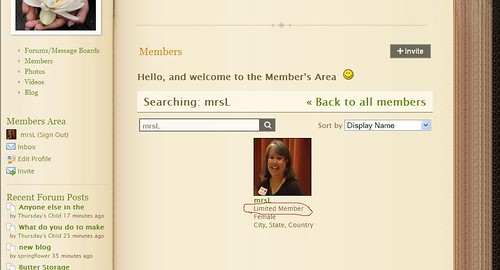
Candy did let me on her forum.
Then she allowed me only limited access.
Now I am still a member but I'm not listed amongst the members.
This is how I look at it. The 200 or so that she has are a captive audience. She does not have a sweeping readership or influence. And, if she does post something outside of the heavily moderated membership area, we have this blog to set the record straight.
So it's all good! She's boxed and contained.
Monday, February 21, 2011
This isn't a home tour but...
here's what half of my living room looks like now that I have teenagers!
(since it's a little slow I didn't think ya'll would mind too much if I posted this!)
(since it's a little slow I didn't think ya'll would mind too much if I posted this!)
Subscribe to:
Posts (Atom)