Pages

Showing posts with label celibacy. Show all posts

Saturday, May 1, 2010

Secular Sex Abuse

Great article in the New York Times about legislation which *finally* targets not only the Catholic Church, but any institution which has hidden abuse.

Should it be possible to sue the city of New York for sexual abuse by public school teachers that happened decades ago? How about doctors or hospital attendants? Police officers? Welfare workers? Playground attendants?

For nearly a year, the city has tiptoed around that question, but in the coming months, there may be no ducking it. Legislation in Albany would force public officials to answer for the crimes of earlier generations, just as Catholic bishops have.
What began as an effort by legislators to expand judicial accountability for sexual abuse by Catholic clergy has grown to cover people in every walk of life. One bill would temporarily suspend the statute of limitations, and allow people who say they were abused as children to file lawsuits up to age 58 — that is, 40 years after they turned 18.

In states which have debated changing the statue of limitations, is the object really to help the victims, or persecute the Catholic Church? If you are really concerned about victims, wouldn't you want to help all of them, and not just those who had abuse related to the Catholic Church?

Suddenly, lobbyists and advocates for school boards, counties and small towns spoke out.
“Statutes of limitation exist for a reason,” said Bob Lowry, the deputy director of the New York State Council of School Superintendents. “How can anyone go back 40 years and ascertain what happened? Witnesses, responsible authorities, even the perpetrator himself or herself, may have passed away.”

Suddenly, indeed.  So you say that you were abused by Father O'Malley back 40 years ago.  Well, he's been dead for 10 years, and the parish housekeeper died even longer ago.  Maybe Bob who was also an altar boy could be a witness, but no one has heard from him in years.  When the Catholic Church says that lifting the statute of limitations poses problems as to how to get a fair trail for both victim AND accused, are they just making excuses, or is this a valid point?  We need to remember that in our legal system you are innocent until proven guilty, and are entitled to a fair trial.

Currently in the state of New York, if you are a child who is abused by a teacher, you have only NINETY DAYS to file a report.  How fair is that?  Surely, we can come to a number which is fair for both public and religious institutions.  

And the New York State School Boards Association said the costs of old misdeeds would be borne by people who had nothing to do with them, and “provide no corresponding protection” to children. The bill ultimately was not voted on last year. It is back again, and no doubt will get fresh life from the continuing stream of revelations about high church officials who covered up abuse. 
No one denies that the victims deserve compensation.  But closing down schools and parishes hurts everyone, as well as denying the poor opportunities for aid which they might have otherwise received.

New York is certainly not the first state to consider such a bill.  Colorado debated this several years ago. 

But many opponents of the bill testified that because sovereign immunity protects public institutions, the bill unfairly targets Catholic and other nonpublic entities. L. Martin Nussbaum, an attorney with Rothberger, Johnson and Lyons Religious Institution Group, said many people believe "that Catholic institutions have a more severe [sexual abuse] problem than others. They do not."
Testifying on behalf of CCPAC, Mr. Nussbaum cited several well-documented cases involving public school teachers, juvenile detention facilities, foster care providers and correctional facilities employees.
"This data shows that there is a substantial, current problem of childhood sexual abuse in Connecticut governmental settings," he said. "It is a much larger, and much more current problem than the problem Catholic institutions largely resolved by 1992. The Catholic Conference can see no reason why the law of Connecticut should discriminate between childhood sexual abuse claimants based upon whether they were injured in a governmental setting or a Catholic setting," he said.


AddThis Social Bookmark Button

Sunday, April 25, 2010

Catholic Sex Scandals, Part III

In part three of "Catholic Sex Scandals" I am addressing the "talk is cheap, when are they going to DO something about it" criticism.

Efforts To Combat Clergy Sexual Abuse Against Minors: A Chronology [USA]
U. S. Bishops Approve Charter to Protect Children and Young People
Restructured Committee on Sexual Abuse Announced
Sex Abuse Committee Releases Preliminary Survey Results
Mixed Commission Ends Work In Rome on Sexual Abuse Charter
Essential Norms for Diocesan/Eparchial Policies Dealing with Allegations of Sexual Abuse of Minors by Priests or Deacons
Guidelines for Implementation of Safe Environment Programs
Training Held on 'Essential Norms'; Vatican Official Took Part
The John Jay Study results [comprehensive study commissioned by the USCCB]
Vatican Report on U.S. Seminaries
Pope blasts Irish bishops, orders Vatican probe
Vatican urges psychological tests on future priests
Guidelines for the use of psychology in the admission and formation of candidates for the priesthood
After an Accusation, Here is What Happens at the Vatican
A Papal Conversion [Article on changing procedures under Cardinal Benedict]
Vatican Publishes Procedures for Sex Abuse Cases
Vatican shows new transparency with online guide


AddThis Social Bookmark Button

Catholic Sex Scandals, Part II

My first entry on this topic concerned the common idea that the root cause of the Catholic sexual abuse problem is celibacy. This entry is to focus on "Why is it so hard for the church and church members to acknowledge the guilt of the priests and repudiate them?"

Pope apologizes to Irish abuse victims, orders Vatican investigation
Irish bishops apologize for 'depravity of abuse' described in Dublin
Catholic Order Apologizes to Abuse Victims
Catholic Bishops Apologize for Sex Abuse
German Bishops Apologize to Child Sex Abuse Victims
Chile's Catholic Church Apologizes for Child Abuse
Swiss bishops apologize, saying they underestimated abuse problem

Catholic bishops deliver full apology for child sex abuse [England and Wales]
U.S. Bishops Apologize for Scandal
Pope Meets Maltese Abuse Victims
Pope Meets With Victims of Sex Abuse By Clergy, Apologizes [USA]
Australia: Pope apologizes for church's sex crimes [bishops]
Pope says sorry to Australian victims of clerical sex abuse
Pope's brother apologizes to abuse victims at his former school
Paedophile priests must own up to their sins, says Vatican [Cardinal Bertone]
Papal preacher apologizes for anti-Semitic remarks

So, how much apologizing is enough? I know, the next remark is "Well, they aren't sincere. They're just apologizing because they got caught." Unfortunately, there is no way to prove sincerity. But to anyone asking the Catholic Church to acknowledge that there is a problem, you got it.


AddThis Social Bookmark Button


Saturday, April 24, 2010

Catholic Sex Scandals

With the new deluge of news articles about the sex scandals in the Catholic Church, I thought it would be important for me to put forth some resources for putting this in perspective.

First, there are not new cases being reported every day. The news articles which are being written are about cases which happened several decades previously.

Second, it is easy to point the finger at the Catholic rule of celibacy for clergy. If this were the case, then there wouldn't be any cases in other churches. However, this is not true at all. Abusers often take positions of authority, and a clergy member has a lot of respect and trust.
You can find cases of abuse in almost all denominations.

Lutheran
Presbyterian
Baptist
Methodist
Pentecostal
Episcopalian

Some question when other churches are going to institute similar policies as the Catholic Church for handling abuse. How soon policies have been adopted vary by denomination.

Most of the abuse in the Catholic cases tended to be of teenage males, which is not actually pedophilia, although most people think of the abuse as being of small children. Most pedophiles are married, not single.

In fact, Catholic priests are no more likely to be abusers than those of other denominations. What about other professions? Several studies have found the rate of abuse by teachers are much higher than that of clergy.

This article from Psychology Today reaffirms the same points that I wanted to make.


AddThis Social Bookmark Button


Saturday, December 12, 2009

Is Priestly Celibacy Biblical?

Photo Sharing and Video Hosting at Photobucket

I first posted this article in 2007. In Candy's latest post on the role of women, she writes about marriage and singleness in the comments. I have interspersed her comments within the article.


Most people are well aware that in the Catholic Church, priests do not marry. (For the record, celibate means "unmarried" in Catholic terminology.)

However, many are unaware that this is not considered a matter of doctrine, but of tradition (with a little t). The Church finds this the best practice for now, but it could change. Although there were both married and celibate (unmarried) priests in the early centuries, the church adopted celibacy as the practice because it made certain things easier at the time, mostly due to inheritance issues. We keep it because we still find it convenient for other reasons.

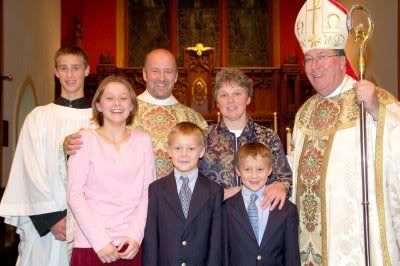
Actually, there are already married priests within the church. In what is known as the Eastern Rites (think Orthodox, but in union with Rome) if men are married when they are ordained, they will be married priests. If they are unmarried when they are ordained, then they must remain so. Also, former Orthodox or Anglican priests who convert, can request to be priests in the Roman Rite. These men, such as Dwight Longenecker, pictured above with his family, will also be married Catholic priests.

Protestants often point to this practice and say that it isn't Biblical. Some might point out the importance of marriage in the Old Testament. The figures of the Old Testament were very much concerned with building the Israelites as God's Chosen People. The New Testament is concerned with building the Kingdom of God.

Who is the central figure who precedes Jesus in the New Testament? John the Baptist, who appears to have been the first monk in the desert. There are many verses in the New Testament which point favorably to remaining unmarried:

Matt 19:12 For there are some eunuchs, which were so born from their mother's womb: and there are some eunuchs, which were made eunuchs of men: and there be eunuchs, which have made themselves eunuchs for the kingdom of heaven's sake. He that is able to receive it, let him receive it.

Matt 19:29 And every one that hath forsaken houses, or brethren, or sisters, or father, or mother, or wife, or children, or lands, for my name's sake, shall receive an hundredfold, and shall inherit everlasting life.

1 Cor 7:1Now concerning the things whereof ye wrote unto me: It is good for a man not to touch a woman.

And you might notice that Paul then goes on to say that everyone should marry, to avoid fornication.

Candy specifically points this out, saying "1 Corinthians 7:1 is referring to the unmarried state. When a man is single, he is not to touch a woman - not to have sexual relations. This is why the next verse begins talking about avoiding fornication. When a man marries, then not only is he to touch his woman - he is commanded to "render due benevolence."

But the line after that is:

1 Cor 7:6 But I speak this by permission, and not of commandment.

7:7 For I would that all men were even as I myself.

He is giving permission for verses 2 though 5. It is not a commandment, because it is better to be as he is, himself. Further down, he writes:

1 Cor 7:27 Art thou bound unto a wife? seek not to be loosed. Art thou loosed from a wife? seek not a wife.

7:32 But I would have you without carefulness. He that is unmarried careth for the things that belong to the Lord, how he may please the Lord:

7:33 But he that is married careth for the things that are of the world, how he may please his wife.

One of the advantages for a celibate priest, is that he can devote himself full time to prayer and ministry, without caring for things of the world, and pleasing his wife.

1 Cor 7:38 So then he that giveth her in marriage doeth well; but he that giveth her not in marriage doeth better.

Candy writes, "Paul cannot be saying that it's better for men to stay single, else he would be contradiction God, when God commanded us to "be fruitful and multiply." We cannot do that unless we marry.

If Paul meant that it is better for men to stay single, then he would also be contradicting himself, for Paul also said the following:


"Now the Spirit speaketh expressly, that in the latter times some shall depart from the faith, giving heed to seducing spirits, and doctrines of devils; Speaking lies in hypocrisy; having their conscience seared with a hot iron; Forbidding to marry, and commanding to abstain from meats, which God hath created to be received with thanksgiving of them which believe and know the truth." -1 Timothy 4:1-3"

I think that the second paragraph is what is leading Candy's interpretation of Paul. She doesn't want to concede that Paul wrote favorably of celibacy, because it could be used to justify the Catholic celibate priesthood. However, the Catholic Church does not forbid anyone from marrying. Those who are ordained priests are usually (though not always, as I wrote above) chosen from single men, who choose to take a vow of celibacy. The Shakers forbade marriage; the Catholic Church does not.

Candy adds further verses to prove her point: Pastors/deacons/bishops (biblically, bishop and pastor are the same office, and deacons are likely elders in the church, BTW) are told to
marry, as well:

"A bishop then must be blameless, the husband of one wife, vigilant,
sober, of good behaviour, given to hospitality, apt to teach" -1
Timothy 3:2

"Let the deacons be the husbands of one wife, ruling their children
and their own houses well." -1 Timothy 3:12

These verses are not commanding bishops and deacons to marry. It is saying that they should not be polygamous. I wonder if Candy would infer that men who are married, but have not been able to have children should not be ordained deacons, since they cannot demonstrate "ruling their children" well.

I don't think that we need to stack the verses speaking favorably of marriage and those speaking favorably of celibacy and measure the two. I think that the New Testament makes it clear that there is now a new choice available. Now some will be called to give themselves entirely to God, and this is a valid choice.

If you look at the history of the Church, it is clear that from the very first years of the Church, people listened to the parable of the rich young man, and took it to apply to themselves. Young widows gathered together in a house and devoted themselves to prayer instead of marrying again. Young men sold all of their possessions and went to pray in the desert. This all happened immediately, not starting in the Middle Ages.

From my point of view, it is the protestant churches which do not allow a person to chose this as an option. If a young man who had graduated from seminary openly said that he had no intention of marrying because he wanted to devote himself to prayer and his work for the church, would he really be able to find a job? On the other hand, the Catholic church has a position of deacon, which is an ordained position available for married men.

Candy actually seems to agree with my position here, as she says "It is great if a person can devote their whole life to God, and not desire a spouse. However, if one desires a spouse, they should not forbid to marry, but should in fact start their own family unit. The unmarried life, devoted completely to God are for those who don't have the desire to marry, and is never biblically forced on anyone."

Candy, who likes to read testimonies about women being held prisoner in convents, clearly views priests as being forced to remain single. They are forbidden from marrying. However, we do not see it that way.

Our seminary process is long, and with ample opportunity for the men to discern if this is truly their calling. I know someone who got married recently, who spent two years in a Catholic seminary. He discerned that he was not called to the priesthood after all. That is not looked down upon at all in our church, but on the other hand, an indication that the process works.

Priests are certainly not unhappy with the state of affairs.

"Job satisfaction is not a problem for U.S. priests, nearly 100 percent of whom either "strongly agree" or "somewhat agree" with the statement: "Overall, I am satisfied with my life as a priest." That was among the findings of the Center for Applied Research in the Apostolate, CARA, in a telephone poll of 1,212 priests released Sept. 9."

A 2007 University of Chicago job satisfaction survey found eighty-seven percent of clergy said they were "very satisfied" with their work. This was all clergy lumped together, which suggests that while protestant clergy are very satisfied with their jobs, that Catholic clergy might be a little happier.

So again, while this is a tradition of the church, there are verses that speak approvingly of celibacy, indicating that it is a Biblically based practice.

The Catholic church isn't the only church with this practice, either. The Orthodox churches ordain both married and unmarried men, but if they are unmarried when ordained, then they must remain so. Bishops are chosen only from the celibate priests.

Orthodox, Anglican, and Catholic churches all have a monastic traditions, as well, where monks and nun devote themselves full time to prayer.


AddThis Social Bookmark Button

Saturday, October 4, 2008

Catholic priests and celibacy

Roman Catholic priests/bishops, etc. are supposed to be celibate, and are forbidden to marry. Furthermore, RCs have certain days where they are not supposed to eat meat.

"A bishop then must be blameless, the husband of one wife, vigilant, sober, of good behaviour, given to hospitality, apt to teach;" -1 Timothy 3:2

Roman Catholic bishops are not allowed to marry, but the Bible commands that Christian bishops are supposed to marry.

October 4, 2008 KTH


The folks at Catholic Answers directly answer Candy's common attack.  I have some of the best excerpts below, but the entire article is a good read.  


Fundamentalists are often surprised to learn that even today celibacy is not the rule for all Catholic priests. In fact, for Eastern Rite Catholics, married priests are the norm, just as they are for Orthodox and Oriental Christians.

Even in the Eastern churches, though, there have always been some restrictions on marriage and ordination. Although married men may become priests, unmarried priests may not marry, and married priests, if widowed, may not remarry. Moreover, there is an ancient Eastern discipline of choosing bishops from the ranks of the celibate monks, so their bishops are all unmarried.

The tradition in the Western or Latin-Rite Church has been for priests as well as bishops to take vows of celibacy, a rule that has been firmly in place since the early Middle Ages. Even today, though, exceptions are made. For example, there are married Latin-Rite priests who are converts from Lutheranism and Episcopalianism.

As these variations and exceptions indicate, priestly celibacy is not an unchangeable dogma but a disciplinary rule. The fact that Peter was married is no more contrary to the Catholic faith than the fact that the pastor of the nearest Maronite Catholic church is married.


All of this is false. Although most people are at some point in their lives called to the married state, the vocation of celibacy is explicitly advocated—as well as practiced—by both Jesus and Paul.

So far from "commanding" marriage in 1 Corinthians 7, in that very chapter Paul actually endorses celibacy for those capable of it: "To the unmarried and the widows I say that it is well for them to remain single as I am. But if they cannot exercise self-control, they should marry. For it is better to marry than to be aflame with passion" (7:8-9).

It is only because of this "temptation to immorality" (7:2) that Paul gives the teaching about each man and woman having a spouse and giving each other their "conjugal rights" (7:3); he specifically clarifies, "I say this by way of concession, not of command. I wish that all were as I myself am. But each has his own special gift from God, one of one kind and one of another" (7:6-7, emphasis added).

Paul even goes on to make a case for preferring celibacy to marriage: "Are you free from a wife? Do not seek marriage. . . those who marry will have worldly troubles, and I would spare you that. . . . The unmarried man is anxious about the affairs of the Lord, how to please the Lord; but the married man is anxious about worldly affairs, how to please his wife, and his interests are divided. And the unmarried woman or girl is anxious about the affairs of the Lord, how to be holy in body and spirit; but the married woman is anxious about worldly affairs, how to please her husband" (7:27-34).

Paul’s conclusion: He who marries "does well; and he who refrains from marriage will do better" (7:38).

Paul was not the first apostle to conclude that celibacy is, in some sense, "better" than marriage. After Jesus’ teaching in Matthew 19 on divorce and remarriage, the disciples exclaimed, "If such is the case between a man and his wife, it is better not to marry" (Matt 19:10). This remark prompted Jesus’ teaching on the value of celibacy "for the sake of the kingdom":


"Not all can accept this word, but only those to whom it is granted. Some are incapable of marriage because they were born so; some, because they were made so by others; some, because they have renounced marriage for the sake of the kingdom of God. Whoever can accept this ought to accept it" (Matt. 19:11–12).


Celibacy is neither unnatural nor unbiblical. "Be fruitful and multiply" is not binding upon every individual; rather, it is a general precept for the human race. Otherwise, every unmarried man and woman of marrying age would be in a state of sin by remaining single, and Jesus and Paul would be guilty of advocating sin as well as committing it.


Another Fundamentalist argument, related to the last, is that marriage is mandatory for Church leaders. For Paul says a bishop must be "the husband of one wife," and "must manage his own household well, keeping his children submissive and respectful in every way; for if a man does not know how to manage his own household, how can he care for God’s Church?" (1 Tim. 3:2, 4–5). This means, they argue, that only a man who has demonstrably looked after a family is fit to care for God’s Church; an unmarried man, it is implied, is somehow untried or unproven.
This interpretation leads to obvious absurdities. For one, if "the husband of one wife" really meant that a bishop had to be married, then by the same logic "keeping his children submissive and respectful in every way" would mean that he had to have children. Childless husbands (or even fathers of only one child, since Paul uses the plural) would not qualify.

In fact, following this style of interpretation to its final absurdity, since Paul speaks of bishops meeting these requirements (not of their having met them, or of candidates for bishop meeting them), it would even follow that an ordained bishop whose wife or children died would become unqualified for ministry! Clearly such excessive literalism must be rejected.

The theory that Church leaders must be married also contradicts the obvious fact that Paul himself, an eminent Church leader, was single and happy to be so. Unless Paul was a hypocrite, he could hardly have imposed a requirement on bishops which he did not himself meet. Consider, too, the implications regarding Paul’s positive attitude toward celibacy in 1 Corinthians 7: the married have worldly anxieties and divided interests, yet only they are qualified to be bishops; whereas the unmarried have single-minded devotion to the Lord, yet are barred from ministry!

.


AddThis Social Bookmark Button