Today's reading touched on a topic that I have been thinking more about lately. Have you noticed that the Christian idea that there will be a bodily resurrection is dying out among mainstream Christians? It is more popular now to think that we will be leaving our inferior bodies behind, to become be joined with God in spirit or as "pure energy."
The resurrection of the dead was a hot topic in the time of Jesus. It has become an accepted tradition that we don't really think about much today, but at the time your view of the resurrection depending on what you accepted as Scripture and your view of tradition versus a literal interpretation of that Scripture.
Luke 20:27-38
Some Sadducees, those who deny that there is a resurrection, came forward and put this question to Jesus, saying, "Teacher, Moses wrote for us, If someone's brother dies leaving a wife but no child, his brother must take the wife and raise up descendants for his brother. Now there were seven brothers; the first married a woman but died childless. Then the second and the third married her, and likewise all the seven died childless. Finally the woman also died. Now at the resurrection whose wife will that woman be? For all seven had been married to her."
Jesus said to them, "The children of this age marry and remarry; but those who are deemed worthy to attain to the coming age and to the resurrection of the dead neither marry nor are given in marriage.
They can no longer die, for they are like angels; and they are the children of God because they are the ones who will rise. That the dead will rise even Moses made known in the passage about the bush,
when he called out 'Lord, ' the God of Abraham, the God of Isaac, and the God of Jacob; and he is not God of the dead, but of the living, for to him all are alive."
The Sadducees were trying to ask Jesus a trick question here. Who were the Sadducees? They were the Jewish group whose worship centered around the Temple, rather than the synagogues. Like the fundamentalists of today, they rejected oral tradition and insisted on a literal interpretation of Scripture. This is why they did not believe in a bodily resurrection, because it did not appear in the Torah. Yes, you read that correctly, the idea of a bodily resurrection does not appear in the Torah. Because Jesus is replying to the Sadducees, who do not accept anything but the Torah, his restrains his answer to the Torah in reply.
Not to criticize Jesus or anything, but I always found his reply a little lacking in proof for the resurrection of the dead. I always thought God was the God of Abraham, Isaac, and Jacob because he was the God that they worshiped. Still, this verse is one that we Catholics reach to as proof that the dead are not unaware of us. If "his is not the God of the dead, but of the living, for to him all are alive" then we can pray for the dead, and they can pray for us, because they are alive with God.
The Jewish belief in a bodily resurrection was only gradually developed. Scholar N.T. Wright writes, "When we turn to ancient Judaism the picture is both very similar and very different. The Hebrew Sheol, the place of the dead, is not very different from Homer’s Hades. People are asleep there; they can sometimes be woken up, as with Saul and Samuel, but to do so is dangerous, and forbidden. That is the picture we get from most of the Old Testament. . . The Sadducees deny the world to come altogether, reminding us that resurrection was and remained an explicitly political doctrine, about God turning the present world and its power structures upside down. Thus the Pharisees’ belief in the resurrection was part of their generally revolutionary ideology: as in Daniel and Maccabees, resurrection was an incentive to martyrdom."
N.T. Wright references the books of Maccabees, which is one of the books which was removed from the protestant canon because it contained references to praying for the dead. Yet removing Maccabees also removes some of the most explicit references to a coming bodily resurrection.
2 Maccabees 7:1-2, 9-14
It happened that seven brothers with their mother were arrested and tortured with whips and scourges by the king, to force them to eat pork in violation of God's law. One of the brothers, speaking for the others, said: "What do you expect to achieve by questioning us? We are ready to die rather than transgress the laws of our ancestors."
At the point of death he said: "You accursed fiend, you are depriving us of this present life, but the King of the world will raise us up to live again forever. It is for his laws that we are dying." After him the third suffered their cruel sport. He put out his tongue at once when told to do so, and bravely held out his hands, as he spoke these noble words: "It was from Heaven that I received these; for the sake of his laws I disdain them; from him I hope to receive them again."
Even the king and his attendants marveled at the young man's courage, because he regarded his sufferings as nothing. After he had died, they tortured and maltreated the fourth brother in the same way. When he was near death, he said, "It is my choice to die at the hands of men with the hope God gives of being raised up by him; but for you, there will be no resurrection to life."
Clearly, Christians today believe in a bodily resurrection because it is explicit in the New Testament scriptures. But the belief in a bodily resurrection by Jesus and the Pharisees was based on their acceptance of oral tradition, and of the inspiration of the deuterocanonical books such as the books of Maccabees.
Showing posts with label Purgatory and the Dead. Show all posts
Showing posts with label Purgatory and the Dead. Show all posts
Sunday, November 7, 2010

Wednesday, March 3, 2010
Purgatory Primer
No new material here, but this is my handout for my class tonight.
Before Christ’s death and resurrection, souls waited redemption in Sheol: Zech 9:11, Eph 4:8-10, 1 Pet 3:19-20
References to those “under the Earth” who are neither in Heaven nor Hell, after Christ’s death and resurrection: Phil 2:10-11, Rev 5:3, 13.
Catholic Catechism #1031 “The Church gives the name Purgatory to this final purification of the elect, which is entirely different from the punishment of the damned. The Church formulated her doctrine of faith on Purgatory especially at the Councils of Florence and Trent. The tradition of the Church, by reference to certain texts of Scripture, speaks of a cleansing fire.”
This punishment isn't in Hell because you can't be saved through hellfire. Also, there's no punishment in Heaven: 1 Corinthians 3:10-16, 2 Corinthians 5:9-11, Hebrews 12:6, 11
#1472 To understand this doctrine and practice of the Church, it is necessary to understand that sin has a double consequence. Grave sin deprives us of communion with God and therefore makes us incapable of eternal life, the privation of which is called the "eternal punishment" of sin. On the other hand every sin, even venial, entails an unhealthy attachment to creatures, which must be purified either here on earth, or after death in the state called Purgatory. This purification frees one from what is called the "temporal punishment" of sin.
#1473 The forgiveness of sin and restoration of communion with God entail the remission of the eternal punishment of sin, but temporal punishment of sin remains.
Temporal punishment is that which is due to sin, even after the sin has been pardoned by God.
CCC #1741 “By his glorious Cross Christ has won salvation for all men. He redeemed them from the sin that held them in bondage.”
Christ promised there was punishment that exacted what was due but wasn't endless. (And Paul supported this teaching.)
Matt 5: 20-26, Matt 12:32, Matt 18:21-35, Matt 25:31-46, Luke 12:58-59, Heb 9:27, Psalm 99:8
We must be spotless and pure in God's presence: Rev 21:27, Matt 5:8, 2 Cor 7:1
Those who are alive can pray for those who are dead (and vice versa): 1 John 5:16-17, Luke 16:19-31, 2 Maccabees 12:38-46, Sirach 7:33
Saturday, October 31, 2009
VTC Prayer For the Dead Compilation
Halloween is the eve of the Feast of All Saints. For many, it is a time to remember and pray for the dead. Here are some of our previous posts of interest.
Elena writes about prayers to and for the dead.
Erika directs us to a history of All Hallow's Eve.
Jimmy Akin gets me musing about what the point would be to NOT pray for the dead.
Candy accuses us of necromancy by saying that we are speaking to the dead.
Some parts of my post on purgatory are also relevant:
2 Tim. 1:16-18 is an example of Paul praying for the dead, in this case, a man named Onesiphorus.Plus, who says Halloween more than Jack Chick!
Praying for the dead was common practice among the Jews at that time. It has been the practice at least as long as the time of the Maccabees. 2 Maccabees 12:43–45 states "In doing this he acted in a very excellent and noble way, inasmuch as he had the resurrection of the dead in view; for if he were not expecting the dead to rise again, it would have been useless and foolish to pray for them in death. But if he did this with a view to the splendid reward that awaits those who had gone to rest in godliness, it was a holy and pious thought. Thus he made atonement for the dead that they might be freed from this sin." These verses are the primary reason that the deuterocanonical books were removed from the Old Testament. They justified praying for the dead.
Praying for the dead remains the Jewish practice today. Orthodox Jews recite the Kaddish for eleven months after the death of a parent, to pray for their purification. Judaism 101 says "According to Jewish tradition, the soul must spend some time purifying itself before it can enter the World to Come."
While many contend that purgatory and praying for the dead was a medieval Roman Catholic invention, there is ample evidence that this was a belief of the early Christians. Visit the catacombs, and you find prayers for the dead scrawled on the wall in examples of graffiti dating to the first three centuries of Christianity.
Other writings of that era such as Acts of Paul and Thecla and the Martyrdom of Perpetua and Felicity also attest to this belief.
The Early Church Fathers, who, being "early" predated Medieval times by quite a bit, also wrote on this topic. Tertullian, writes in the second century, "We offer sacrifices for the dead on their birthday anniversaries [the date of death—birth into eternal life]."
Joe Carter takes a stroll down memory lane as he contemplates the annual ritual of handing out Chick tracts with Halloween treats.
To me, though, Chick is not just another anti-Catholic bigot. When I was a kid Jack Chick was the man who was responsible for more nightmares than the Twilight Zone and Kolchak: The Nightstalker combined. Chick not only scared the hell out of me, he made me afraid that hell was all around me.
Sunday, September 6, 2009
Assumption talk
Really guys! It is helpful if you keep comments on the blog topic so that when people are looking for information on the Assumption, they can find it!
I'm going to try and gather several of the comments together here, so that those who wish to continue discussing may do so.
Elena pasted from this article:
Well, I hope you don't celebrate Christmas, or worship on Sunday, or use grape juice instead of wine for the Lord's Supper. Because that all sounds good, but none of it is from Scripture.
Jennie replied:
I then wrote:
Jennie's response:
Clare chimed in with:
Daughter of Wisdom wrote this (in response to Clare):
Finally, Barbara wrote:
Now, let us try to get back to the original question. How does the doctrine of the Assumption contradict Scripture?
The only response I've heard is that it would have been an important enough event that it should have been in Scripture. That is not proof of contradiction, folks.
Can God assume bodies into Heaven? Yes, there is Biblical proof of this.
Is Mary's death recorded in Scripture? No, it is not.
Therefore, this doctrine does not explicitly contradict Scripture.
Going back to Jennie's other original assertion, that traditions practiced by non-Catholic Christians are not major doctrines, but matters of personal choice in minor matters, I would point out the the doctrine of the Trinity is a major cornerstone of Christianity which was not explicitly mentioned in Scripture. It was also not agreed upon by the early Christians for this reason. The early church was nearly torn apart by this controversy, but eventually Arianism was declared a heresy.
So yes, Jennie, it is possible for major doctrines to not be explicitly found in Scripture.
As to the history of Mary. At the crucifixion of Jesus, Jesus gave Mary into the care of the apostle John. It is widely believed that Mary went to live with John in the city of Ephesus. The place where the house stood is a place of pilgrimage for both Christians and Muslims today. While the upper part of the house is newer, the foundations date back to the 1st century.
While Mary lived there, it is reasonable to assume that the disciples of Jesus came to visit her there. Luke does not name his "eyewitnesses" but from whom else would he have heard of the circumstances of the birth of Jesus? Was elderly Elizabeth still around to tell how John the Baptist leaped in her womb when Mary came to visit her?
St. John died and was buried in Ephesus, where a church was erected over his grave. The remains of it are still there. Similarly, the location of the tomb of Mary is still remembered with a church, which was built over the site of 1st century burial caves.
These people were very important to the early Christians. They began collecting "relics" from them. In Acts 19:11-12 it is recorded that people were healed of illness and possession by being touched by aprons or handkerchiefs which had touched Paul. That proved so successful, they kept track of Paul when he died.
The early Christians visited tombs of the martyrs and of significant Christians regularly. There exists ample historical evidence of this in the form of 1st century graffiti on the tombs. The Christians honored and remembered their dead. They made pilgrimage to their tombs. And when the persecution was over, churches were erected on these sites.
Consider the most significant example of this, the tomb of St. Peter in Rome. No, we can't prove that the DNA on the bones matches that of St. Peter. But it is becoming clear that with so many of these sites, they do date back to the earliest times. Christians honored and remembered their dead.
I'm going to try and gather several of the comments together here, so that those who wish to continue discussing may do so.
Elena pasted from this article:
I said to Jennie:
The Assumption is the oldest feast day of Our Lady, but we don't know how it first came to be celebrated.
Its origin is lost in those days when Jerusalem was restored as a sacred city, at the time of the Roman Emperor Constantine (c. 285-337). By then it had been a pagan city for two centuries, ever since Emperor Hadrian (76-138) had leveled it around the year 135 and rebuilt it as Aelia Capitolina in honor of Jupiter.
For 200 years, every memory of Jesus was obliterated from the city, and the sites made holy by His life, death and Resurrection became pagan temples.
After the building of the Church of the Holy Sepulchre in 336, the sacred sites began to be restored and memories of the life of Our Lord began to be celebrated by the people of Jerusalem. One of the memories about his mother centered around the "Tomb of Mary," close to Mount Zion, where the early Christian community had lived.
On the hill itself was the "Place of Dormition," the spot of Mary's "falling asleep," where she had died. The "Tomb of Mary" was where she was buried.
At this time, the "Memory of Mary" was being celebrated. Later it was to become our feast of the Assumption.
For a time, the "Memory of Mary" was marked only in Palestine, but then it was extended by the emperor to all the churches of the East. In the seventh century, it began to be celebrated in Rome under the title of the "Falling Asleep" ("Dormitio") of the Mother of God.
Well, I hope you don't celebrate Christmas, or worship on Sunday, or use grape juice instead of wine for the Lord's Supper. Because that all sounds good, but none of it is from Scripture.
Jennie replied:
I don't consider Christmas as a part of church doctrine. It's a tradition that some celebrate as part of church worship and some celebrate as just a family and cultural tradition. It's certainly not something that was commanded in scripture or done in the early church.
As to the other things, they are not major doctrines pertaining to salvation, but would be considered matters of freedom and conscience, as to what day to worship, and whether to use alcoholic wine for communion. There is not agreement on them, so we should do as conscience dictates. We don't believe traditions are bad, just that they must be in line with scripture.
The RC doctrines of Mary are not taught in scripture AND are in contradiction to it. They are myths with no historical support and, in protestant eyes, should not be believed and certainly should not be dogmas that everyone must believe. In the firm belief of many Christians, they take away from the supremacy of Christ and the gospel message, and point people to Mary instead.
I then wrote:
I get very frustrated that things non-Catholic Christians do which are traditions are always okay, even though they aren't Scriptural. Anything Catholics do which smack of tradition (such as pray the rosary) is met with the accusation that it isn't in the Bible, and therefore shouldn't be done.
How does the Assumption contradict Scripture, which is silent on what happened to Mary. Elijah and Enoch were assumed into heaven.
I would also disagree that there is no historical support. In my blog entry which I linked to earlier, you can see that the church which holds Mary's empty tomb is still around. Historical accounts always refer to an empty tomb.
It isn't as if there are accounts of the body being there, and then at a certain point they change to describing an empty tomb, as it would if the body were stolen.
Jennie's response:
I haven't heard of Mary's empty tomb. When does history speak of it? I've heard of many people going to the Holy Land to see Jesus' empty tomb, but not Mary's. I'll go back and look at your earlier blog entry.
The Bible records Jesus' resurrection and ascension, and earlier as you said it records Elijah and Enoch being taken up into heaven alive, so if Mary was assumed and it's so important to Christianity, why is it not recorded in scripture and testified to by early believers by many eyewitnesses as Jesus' death and resurrection and ascension were?
It looks like all the documents that refer to the assumption are from the 5th century or later. That's not the same as the eyewitness accounts of Christ and the historical accounts from the same period as Christ that speak of the events of the time. It still looks like the Mary stories came in later as myths.
Clare chimed in with:
It is a little bit intriguing to observe the lack of relics of Mary. No 'true bones' or anything.
The early church ( and this habit persists) tended to treat the mortal remains of saints with great care and reverence.
Daughter of Wisdom wrote this (in response to Clare):
I can shed a little light on why the body of Mary was not found.
The burial practices of 1st century Jews were markedly different from the modern burial practices of today, or of our culture. In first century Jewry, bodies were not embalmed or preserved. The body was anointed with special herbs such as myrrh or aloes to mask the stench as the body decomposed. Once the body had decomposed, the bones were taken and placed in a box called an ossuary, which contained all the bones of a particular family. These ossuaries were then stored in special burial caves where they could be retrieved at any time so that new bones from newly deceased family members could be added. For more information see Ossuary.
Another thing: The name Mary was very common back then. It would have been difficult to next to impossible for a devout Catholic who came along hundreds of years later (as there were no Roman Catholics in the first century) to to determine which bones belonged to Mary of Nazareth. The destruction of familial records by the then Roman empire, and the Jewish diaspora of 70 A.D would also make it virtually impossible for people to identify remains.
Conclusion: No body of Mary because the body had rotted away, and the documentation to identify the bones were destroyed.
Finally, Barbara wrote:
Much of what is known about Mary is found in the NT apocrypha. While some of these books were rejected from the official canon as heretical, others were rejected because their authorship was questioned, not their validity. Other things were passed down in oral tradition.---------------
The reason that many doctrines about Mary were officially declared was in response to those questioning Jesus' humanity. Jesus was fully human because his mother was fully human. Would you not agree that a central tenent is that Christ was both human and divine.
Now, let us try to get back to the original question. How does the doctrine of the Assumption contradict Scripture?
The only response I've heard is that it would have been an important enough event that it should have been in Scripture. That is not proof of contradiction, folks.
Can God assume bodies into Heaven? Yes, there is Biblical proof of this.
Is Mary's death recorded in Scripture? No, it is not.
Therefore, this doctrine does not explicitly contradict Scripture.
Going back to Jennie's other original assertion, that traditions practiced by non-Catholic Christians are not major doctrines, but matters of personal choice in minor matters, I would point out the the doctrine of the Trinity is a major cornerstone of Christianity which was not explicitly mentioned in Scripture. It was also not agreed upon by the early Christians for this reason. The early church was nearly torn apart by this controversy, but eventually Arianism was declared a heresy.
So yes, Jennie, it is possible for major doctrines to not be explicitly found in Scripture.
As to the history of Mary. At the crucifixion of Jesus, Jesus gave Mary into the care of the apostle John. It is widely believed that Mary went to live with John in the city of Ephesus. The place where the house stood is a place of pilgrimage for both Christians and Muslims today. While the upper part of the house is newer, the foundations date back to the 1st century.
While Mary lived there, it is reasonable to assume that the disciples of Jesus came to visit her there. Luke does not name his "eyewitnesses" but from whom else would he have heard of the circumstances of the birth of Jesus? Was elderly Elizabeth still around to tell how John the Baptist leaped in her womb when Mary came to visit her?
St. John died and was buried in Ephesus, where a church was erected over his grave. The remains of it are still there. Similarly, the location of the tomb of Mary is still remembered with a church, which was built over the site of 1st century burial caves.
These people were very important to the early Christians. They began collecting "relics" from them. In Acts 19:11-12 it is recorded that people were healed of illness and possession by being touched by aprons or handkerchiefs which had touched Paul. That proved so successful, they kept track of Paul when he died.
The early Christians visited tombs of the martyrs and of significant Christians regularly. There exists ample historical evidence of this in the form of 1st century graffiti on the tombs. The Christians honored and remembered their dead. They made pilgrimage to their tombs. And when the persecution was over, churches were erected on these sites.
Consider the most significant example of this, the tomb of St. Peter in Rome. No, we can't prove that the DNA on the bones matches that of St. Peter. But it is becoming clear that with so many of these sites, they do date back to the earliest times. Christians honored and remembered their dead.
Saturday, August 15, 2009
Feast of the Assumption
Repost from last year.

Today is the feast day of the Assumption of Mary. This is the doctrine that, at the end of her life, Mary was bodily assumed into Heaven. The Catholic Church has not defined whether or not she actually died, but it is traditional to believe that she was assumed after her death. She did not ascend to Heaven by her own power, as Jesus did, but was assumed in another way.
I've often thought this should be one of the easier Catholic Marian doctrines. I've often heard "But it isn't in the Bible!" There are lots of things not recorded in the Bible that still happened. For example, tradition says that St. Thomas carried the Gospel to India, and there is evidence that it happened. The knowledge of what happened to Mary after her death is not necessary for salvation.
Also, there is biblical precedent for humans being assumed into heaven. Ever hear of Enoch and Elijah?
Gen 5:24 And Enoch walked with God: and he was not; for God took him.
2 Kings 2:11 As they were walking along and talking together, suddenly a chariot of fire and horses of fire appeared and separated the two of them, and Elijah went up to heaven in a whirlwind.
You can read a short history of the celebration of this feast.
This website contains the text of early Christian documents relating to the death and assumption of Mary.
Scripture Catholic has quotations from the early Church regarding this doctrine.
You can view photos of Mary's tomb and the church built over it at this website.

Today is the feast day of the Assumption of Mary. This is the doctrine that, at the end of her life, Mary was bodily assumed into Heaven. The Catholic Church has not defined whether or not she actually died, but it is traditional to believe that she was assumed after her death. She did not ascend to Heaven by her own power, as Jesus did, but was assumed in another way.
I've often thought this should be one of the easier Catholic Marian doctrines. I've often heard "But it isn't in the Bible!" There are lots of things not recorded in the Bible that still happened. For example, tradition says that St. Thomas carried the Gospel to India, and there is evidence that it happened. The knowledge of what happened to Mary after her death is not necessary for salvation.
Also, there is biblical precedent for humans being assumed into heaven. Ever hear of Enoch and Elijah?
Gen 5:24 And Enoch walked with God: and he was not; for God took him.
2 Kings 2:11 As they were walking along and talking together, suddenly a chariot of fire and horses of fire appeared and separated the two of them, and Elijah went up to heaven in a whirlwind.
We have written several times about the parallels between Mary and the Ark of the Covenant. If the Ark, which contained God, was hidden until the end of the time, then why should Mary's body, which also contained God, be left on Earth to decay?
- When Jeremiah arrived there, he found a room in a cave in which he put the tent, the ark, and the altar of incense; then he blocked up the entrance. Some of those who followed him came up intending to mark the path, but they could not find it.
- When Jeremiah heard of this, he reproved them: "The place is to remain unknown until God gathers his people together again and shows them mercy.
You can read a short history of the celebration of this feast.
After the building of the Church of the Holy Sepulchre in 336, the sacred sites began to be restored and memories of the life of Our Lord began to be celebrated by the people of Jerusalem. One of the memories about his mother centered around the "Tomb of Mary," close to Mount Zion, where the early Christian community had lived.
On the hill itself was the "Place of Dormition," the spot of Mary's "falling asleep," where she had died. The "Tomb of Mary" was where she was buried.
At this time, the "Memory of Mary" was being celebrated. Later it was to become our feast of the Assumption. . .
Soon the name was changed to the "Assumption of Mary," since there was more to the feast than her dying. It also proclaimed that she had been taken up, body and soul, into heaven.
That belief was ancient, dating back to the apostles themselves. What was clear from the beginning was that there were no relics of Mary to be venerated, and that an empty tomb stood on the edge of Jerusalem near the site of her death. That location also soon became a place of pilgrimage. (Today, the Benedictine Abbey of the Dormition of Mary stands on the spot.)
At the Council of Chalcedon in 451, when bishops from throughout the Mediterranean world gathered in Constantinople, Emperor Marcian asked the Patriarch of Jerusalem to bring the relics of Mary to Constantinople to be enshrined in the capitol. The patriarch explained to the emperor that there were no relics of Mary in Jerusalem, that "Mary had died in the presence of the apostles; but her tomb, when opened later . . . was found empty and so the apostles concluded that the body was taken up into heaven."
This website contains the text of early Christian documents relating to the death and assumption of Mary.
Scripture Catholic has quotations from the early Church regarding this doctrine.
“If the Holy Virgin had died and was buried, her falling asleep would have been surrounded with honour, death would have found her pure, and her crown would have been a virginal one...Had she been martyred according to what is written: 'Thine own soul a sword shall pierce', then she would shine gloriously among the martyrs, and her holy body would have been declared blessed; for by her, did light come to the world."
Epiphanius, Panarion, 78:23 (A.D. 377)."[T]he Apostles took up her body on a bier and placed it in a tomb; and they guarded it, expecting the Lord to come. And behold, again the Lord stood by them; and the holy body having been received, He commanded that it be taken in a cloud into paradise: where now, rejoined to the soul, [Mary] rejoices with the Lord's chosen ones..." Gregory of Tours, Eight Books of Miracles, 1:4 (inter A.D. 575-593).
"As the most glorious Mother of Christ, our Savior and God and the giver of life and immortality, has been endowed with life by him, she has received an eternal incorruptibility of the body together with him who has raised her up from the tomb and has taken her up to himself in a way known only to him." Modestus of Jerusalem, Encomium in dormitionnem Sanctissimae Dominae nostrae Deiparae semperque Virginis Mariae (PG 86-II,3306),(ante A.D. 634).
"It was fitting ...that the most holy-body of Mary, God-bearing body, receptacle of God, divinised, incorruptible, illuminated by divine grace and full glory ...should be entrusted to the earth for a little while and raised up to heaven in glory, with her soul pleasing to God." Theoteknos of Livias, Homily on the Assumption (ante A.D. 650).
You can view photos of Mary's tomb and the church built over it at this website.
Thursday, February 12, 2009
Indulgences
I wrote an article on indulgences previously, due to requests. I see that Ten Reasons has a good indulgences post up right now. Rich discusses errors in a newspaper article. A good reminder that just because it is in the newspaper, doesn't mean that it is theologically correct.
Time after time . . .
Time after time . . .
Sunday, November 2, 2008
Feast of All Souls and Indulgences
As I just posted about prayers for the dead, I thought the Feast of All Souls would be a good time to write about indulgences. We've had several requests for an article on that topic, but I have never gotten around to it previously.
According to popular mythology, indulgences are a way to "buy your way out of purgatory." Indulgences frequently come up in attacks on the Catholic Church.
The medieval church did not actually sell indulgences, but that was an abuse that went on, unofficially. Similar to church fundraisers that you might attend today where there is a "suggested donation" price tag on things, the indulgence was for almsgiving, but functioned in practice as having been sold. Certainly, there was abuse there, and it was reformed by the Council of Trent.
I've found the best way to explain the doctrine behind indulgences is with a little story, so bear with me.
Suppose we have a family that is getting ready for a big Christmas feast. A little boy is dressed in his finest clothes, but there is still an hour before the guests arrive, and he begs his mother to go outside and play. His mother says he might, but makes him promise that he must NOT play in the mud! The boy promises, and out he goes. But, like my little 5 year old boy, he soon forgets, and when his mother comes to call him, she finds he is covered in mud. Now the boy is very sorry, and he begs forgiveness from his mother. And she immediately forgives him. But, because he is covered in mud, he needs to take a nice hot bath to be cleansed of the mud before he can join in the feast. The bath doesn't effect his forgiveness, because he was immediately forgiven. It just removes the results of his sin, so that he can enter into the feast purified.
So that is meant to explain purgatory, but it doesn't really tie indulgences in yet. Indulgences would be if the boy saw that he had done wrong, and tried to wash himself off with the garden hose, as a way of showing his mother how sorry he is. It doesn't effect his forgiveness, because he will be completely forgiven either way. But it might make for a shorter bath.
We call the bath, or purgatory, "temporal punishment." It isn't a punishment that is supposed to earn our salvation, because Jesus did all of that for us already. It is supposed to be part of a cleansing process that removes the stain of sin from our souls, because nothing impure can enter heaven.
The technical definition of an indulgences is "a remission of the temporal punishment due to sin, the guilt of which has been forgiven." This shows that the Catholic Church is not teaching that "Christ was not enough." We recognize that our guilt has already been forgiven through the death and resurrection of Christ.
Clear as mud? Let some better apologists than myself explain it.
A nice basic primer on indulgences
Catholic Answer's Myths About Indulgences
Dave Armstrong gives biblical evidence for indulgences
Feeling brave? Here's the official doctrine on indulgences from the Enchiridion.
According to popular mythology, indulgences are a way to "buy your way out of purgatory." Indulgences frequently come up in attacks on the Catholic Church.
The medieval church did not actually sell indulgences, but that was an abuse that went on, unofficially. Similar to church fundraisers that you might attend today where there is a "suggested donation" price tag on things, the indulgence was for almsgiving, but functioned in practice as having been sold. Certainly, there was abuse there, and it was reformed by the Council of Trent.
Whereas the power of conferring Indulgences was granted by Christ to the Church; and she has, even in the most ancient times, used the said power, delivered unto her of God; the sacred holy Synod teaches, and enjoins, that the use of Indulgences, for the Christian people most salutary, and approved of by the authority of sacred Councils, is to be retained in the Church; and It condemns with anathema those who either assert, that they are useless; or who deny that there is in the Church the power of granting them. In granting them, however, It desires that, in accordance with the ancient and approved custom in the Church, moderation be observed; lest, by excessive facility, ecclesastical discipline be enervated. And being desirous that the abuses which have crept therein, and by occasion of which this honourable name of Indulgences is blasphemed by heretics, be amended and corrected, It ordains generally by this decree, that all evil gains for the obtaining thereof,--whence a most prolific cause of abuses amongst the Christian people has been derived,--be wholly abolished. But as regards the other abuses which have proceeded from superstition, ignorance, irreverence, or from what soever other source, since, by reason of the manifold corruptions in the places and provinces where the said abuses are committed, they cannot conveniently be specially prohibited; It commands all bishops, diligently to collect, each in his own church, all abuses of this nature, and to report them in the first provincial Synod; that, after having been reviewed by the opinions of the other bishops also, they may forthwith be referred to the Sovereign Roman Pontiff, by whose authority and prudence that which may be expedient for the universal Church will be ordained; that this the gift of holy Indulgences may be dispensed to all the faithful, piously, holily, and incorruptly.Indulgences were not abolished, however, and are still around in the church today. I would guess that the average Catholic thinks that they were done away with, like purgatory, after Vatican II. Obtaining an indulgence, like saying a Hail Mary, is not anything required of a Catholic, and you can be a good Catholic and never attempt to gain an indulgence.
I've found the best way to explain the doctrine behind indulgences is with a little story, so bear with me.
Suppose we have a family that is getting ready for a big Christmas feast. A little boy is dressed in his finest clothes, but there is still an hour before the guests arrive, and he begs his mother to go outside and play. His mother says he might, but makes him promise that he must NOT play in the mud! The boy promises, and out he goes. But, like my little 5 year old boy, he soon forgets, and when his mother comes to call him, she finds he is covered in mud. Now the boy is very sorry, and he begs forgiveness from his mother. And she immediately forgives him. But, because he is covered in mud, he needs to take a nice hot bath to be cleansed of the mud before he can join in the feast. The bath doesn't effect his forgiveness, because he was immediately forgiven. It just removes the results of his sin, so that he can enter into the feast purified.
So that is meant to explain purgatory, but it doesn't really tie indulgences in yet. Indulgences would be if the boy saw that he had done wrong, and tried to wash himself off with the garden hose, as a way of showing his mother how sorry he is. It doesn't effect his forgiveness, because he will be completely forgiven either way. But it might make for a shorter bath.
We call the bath, or purgatory, "temporal punishment." It isn't a punishment that is supposed to earn our salvation, because Jesus did all of that for us already. It is supposed to be part of a cleansing process that removes the stain of sin from our souls, because nothing impure can enter heaven.
The technical definition of an indulgences is "a remission of the temporal punishment due to sin, the guilt of which has been forgiven." This shows that the Catholic Church is not teaching that "Christ was not enough." We recognize that our guilt has already been forgiven through the death and resurrection of Christ.
Clear as mud? Let some better apologists than myself explain it.
A nice basic primer on indulgences
Catholic Answer's Myths About Indulgences
Dave Armstrong gives biblical evidence for indulgences
Feeling brave? Here's the official doctrine on indulgences from the Enchiridion.
Friday, October 31, 2008
VTC Prayer for the Dead compilation
Halloween is the eve of the Feast of All Saints. For many, it is a time to remember and pray for the dead. Even Candy's Meez seems to be praying in a cemetery. Here are some of our previous posts of interest.
Elena writes about prayers to and for the dead.
Jimmy Akin gets me musing about what the point would be to NOT pray for the dead.
Candy accuses us of necromancy by saying that we are speaking to the dead.
Some parts of my post on purgatory are also relevant:
Elena writes about prayers to and for the dead.
Jimmy Akin gets me musing about what the point would be to NOT pray for the dead.
Candy accuses us of necromancy by saying that we are speaking to the dead.
Some parts of my post on purgatory are also relevant:
2 Tim. 1:16-18 is an example of Paul praying for the dead, in this case, a man named Onesiphorus.
Praying for the dead was common practice among the Jews at that time. It has been the practice at least as long as the time of the Maccabees. 2 Maccabees 12:43–45 states "In doing this he acted in a very excellent and noble way, inasmuch as he had the resurrection of the dead in view; for if he were not expecting the dead to rise again, it would have been useless and foolish to pray for them in death. But if he did this with a view to the splendid reward that awaits those who had gone to rest in godliness, it was a holy and pious thought. Thus he made atonement for the dead that they might be freed from this sin." These verses are the primary reason that the deuterocanonical books were removed from the Old Testament. They justified praying for the dead.
Praying for the dead remains the Jewish practice today. Orthodox Jews recite the Kaddish for eleven months after the death of a parent, to pray for their purification. Judaism 101 says "According to Jewish tradition, the soul must spend some time purifying itself before it can enter the World to Come."
While many contend that purgatory and praying for the dead was a medieval Roman Catholic invention, there is ample evidence that this was a belief of the early Christians. Visit the catacombs, and you find prayers for the dead scrawled on the wall in examples of graffiti dating to the first three centuries of Christianity.
Other writings of that era such as Acts of Paul and Thecla and the Martyrdom of Perpetua and Felicity also attest to this belief.
The Early Church Fathers, who, being "early" predated Medieval times by quite a bit, also wrote on this topic. Tertullian, writes in the second century, "We offer sacrifices for the dead on their birthday anniversaries [the date of death—birth into eternal life]."
Saturday, October 25, 2008
Oh my soul!
Today Candy is musing on the nature of soul versus spirit, and the afterlife. Does she have your head spinning? Me too. But in case you are curious, here are some Catholic resources on those topics.
From the Catholic Catechism:
"HE DESCENDED INTO HELL. ON THE THIRD DAY HE ROSE AGAIN" 632-635
Catholic Encyclopedia on the soul and spirit. You can also read about hell, and the harrowing of hell, which Candy alludes to when she says "When Jesus died, he preached to
and set free those in the paradise compartment, and they got to go to
heaven, to await their resurrection."
Candy mentions Sheol/Hades: As for hell, that's pretty cut and dry. Sheol/Hades is the holding compartment that the ungodly souls depart to upon death. After the
future judgment, those ungodly souls will be judged, and cast into
Gehenna - the Lake of Fire.
This is where Candy says that Catholics will go after death. She said once that there is a purgatory, but that Catholics will be surprised to learn that they will be dumped from there into hell, rather than go to heaven.
As an interesting side note, Candy refers to Dake and Gail Riplinger as helping her to come to her interpretation. While Catholics often hear that the Bible alone should be our soul authority, and we should cease relying on the interpretations of men, most Christians do rely on various Christian authorities in their interpretations. Candy is no different.
From the Catholic Catechism:
II. "BODY AND SOUL BUT TRULY ONE" 362-368
The human person, created in the image of God, is a being at once corporeal and spiritual. The biblical account expresses this reality in symbolic language when it affirms that "then the LORD God formed man of dust from the ground, and breathed into his nostrils the breath of life; and man became a living being." Man, whole and entire, is therefore willed by God.
In Sacred Scripture the term "soul" often refers to human life or the entire human person. But "soul" also refers to the innermost aspect of man, that which is of greatest value in him, that by which he is most especially in God's image: "soul" signifies the spiritual principle in man.
The human body shares in the dignity of "the image of God": it is a human body precisely because it is animated by a spiritual soul, and it is the whole human person that is intended to become, in the body of Christ, a temple of the Spirit:
- Man, though made of body and soul, is a unity. Through his very bodily condition he sums up in himself the elements of the material world. Through him they are thus brought to their highest perfection and can raise their voice in praise freely given to the Creator. For this reason man may not despise his bodily life. Rather he is obliged to regard his body as good and to hold it in honor since God has created it and will raise it up on the last day.
The unity of soul and body is so profound that one has to consider the soul to be the "form" of the body: i.e., it is because of its spiritual soul that the body made of matter becomes a living, human body; spirit and matter, in man, are not two natures united, but rather their union forms a single nature.
The Church teaches that every spiritual soul is created immediately by God - it is not "produced" by the parents - and also that it is immortal: it does not perish when it separates from the body at death, and it will be reunited with the body at the final Resurrection.
Sometimes the soul is distinguished from the spirit: St. Paul for instance prays that God may sanctify his people "wholly", with "spirit and soul and body" kept sound and blameless at the Lord's coming. The Church teaches that this distinction does not introduce a duality into the soul. "Spirit" signifies that from creation man is ordered to a supernatural end and that his soul can gratuitously be raised beyond all it deserves to communion with God.
The spiritual tradition of the Church also emphasizes the heart, in the biblical sense of the depths of one's being, where the person decides for or against God."HE DESCENDED INTO HELL. ON THE THIRD DAY HE ROSE AGAIN" 632-635
The frequent New Testament affirmations that Jesus was "raised from the dead" presuppose that the crucified one sojourned in the realm of the dead prior to his resurrection. This was the first meaning given in the apostolic preaching to Christ's descent into hell: that Jesus, like all men, experienced death and in his soul joined the others in the realm of the dead. But he descended there as Savior, proclaiming the Good News to the spirits imprisoned there.
Scripture calls the abode of the dead, to which the dead Christ went down, "hell" - Sheol in Hebrew or Hades Such is the case for all the dead, whether evil or righteous, while they await the Redeemer: which does not mean that their lot is identical, as Jesus shows through the parable of the poor man Lazarus who was received into "Abraham's bosom":in Greek - because those who are there are deprived of the vision of God. "It is precisely these holy souls, who awaited their Savior in Abraham's bosom, whom Christ the Lord delivered when he descended into hell." Jesus did not descend into hell to deliver the damned, nor to destroy the hell of damnation, but to free the just who had gone before him.
"The gospel was preached even to the dead." The descent into hell brings the Gospel message of salvation to complete fulfillment. This is the last phase of Jesus' messianic mission, a phase which is condensed in time but vast in its real significance: the spread of Christ's redemptive work to all men of all times and all places, for all who are saved have been made sharers in the redemption.
Christ went down into the depths of death so that "the dead will hear the voice of the Son of God, and those who hear will live." Jesus, "the Author of life", by dying destroyed "him who has the power of death, that is, the devil, and [delivered] all those who through fear of death were subject to lifelong bondage." Henceforth the risen Christ holds "the keys of Death and Hades", so that "at the name of Jesus every knee should bow, in heaven and on earth and under the earth."
You can read quotes from the Early Church Fathers on hell.
Catholic Encyclopedia on the soul and spirit. You can also read about hell, and the harrowing of hell, which Candy alludes to when she says "When Jesus died, he preached to
and set free those in the paradise compartment, and they got to go to
heaven, to await their resurrection."
Candy mentions Sheol/Hades: As for hell, that's pretty cut and dry. Sheol/Hades is the holding compartment that the ungodly souls depart to upon death. After the
future judgment, those ungodly souls will be judged, and cast into
Gehenna - the Lake of Fire.
This is where Candy says that Catholics will go after death. She said once that there is a purgatory, but that Catholics will be surprised to learn that they will be dumped from there into hell, rather than go to heaven.
As an interesting side note, Candy refers to Dake and Gail Riplinger as helping her to come to her interpretation. While Catholics often hear that the Bible alone should be our soul authority, and we should cease relying on the interpretations of men, most Christians do rely on various Christian authorities in their interpretations. Candy is no different.
Thursday, August 7, 2008
Prayer For the Dead
Jimmy Akin discusses prayer for the dead over at his blog.
What would the reason be to not pray for the dead? People have told me that there is just no point, because everything is already decided. Maybe it is, but there is no way to know that for sure. Don't we pray for a miraculous recovery for people in circumstances where there is no hope? With God, there is always hope.
Is God going to somehow punish us for praying for souls out of Christian love and concern? I know that God is a God of mercy, and even if our prayers for the dead are of no effect, then it is still the merciful thing to do, in case they do have an effect.
He also goes into a question that I've always had:I therefore would question whether citing Maccabees is "not enough" as proof of prayer for the dead. It may not be enough for Protestants, because this book was removed from their Old Testament precisely in order to get rid of the passage dealing with prayer for the dead, but since this passage remains in the Catholic Bible, it should be enough for Catholics.
A Catholic thus might say to an Evangelical, "This passage is in my Bible. I accept it. So it is enough for me. It may not be enough for you because you do not find it in your Bible, but you should think about why that is: The reason is that your religious forebears took this passage out of the Protestant Old Testament precisely because they didn't like what it said."
A Catholic might continue by pointing out that prayer for the dead was a practice rooted in the Judeo-Christian tradition even before the time of Christ, as witnessed by the passage in 2 Maccabees, that Jews still pray for the dead today, and that the vast majority of Christians (i.e., Catholic plus Orthodox and other Eastern Christians) pray for the dead. It is only Protestants who do not.
Therefore, one could argue that if we accept that the Judeo-Christian tradition represents the line of religious belief that, in its broad outlines, is true and that God has worked with to shape, and if a particular practice is acknowledged by the great majority of this tradition, then it would seem that it should be those who do not accept the practice in question should have to argue for why it should not be accepted.
Thus ask the Evangelical: "What is your biblical argument that we should not pray for the dead? In particular, in view of St. Paul's emphasis on Christian liberty, where is your biblical proof that Christians should not have the liberty to pray for their departed loved ones?"
What would the reason be to not pray for the dead? People have told me that there is just no point, because everything is already decided. Maybe it is, but there is no way to know that for sure. Don't we pray for a miraculous recovery for people in circumstances where there is no hope? With God, there is always hope.
Is God going to somehow punish us for praying for souls out of Christian love and concern? I know that God is a God of mercy, and even if our prayers for the dead are of no effect, then it is still the merciful thing to do, in case they do have an effect.
Tuesday, April 1, 2008
Catholic Necromancy
There shall not be found among you any one that maketh his son or his daughter to pass through the fire, or that useth divination, or an observer of times, or an enchanter, or a witch. Or a charmer, or a consulter with familiar spirits, or a wizard, or a necromancer [necromancy - the black art of speaking to the dead]. For all that do these things are an abomination unto the LORD: and because of these abominations the LORD thy God doth drive them out from before thee. Deuteronomy 8:10-12
Is necromancy just speaking to the dead, as per Candy's definition?
Merriam Webster says 1 : conjuration of the spirits of the dead for purposes of magically revealing the future or influencing the course of events
Dictionary.com says 1.a method of divination through alleged communication with the dead; black art.
Catholic Encyclopedia says "a special mode of divination by the evocation of the dead.
Clearly there is more to necromancy than just speaking to the dead. How many times do people go to a cemetery and speak to someone at their grave site? Is that necromancy?
Necromancy would include summoning or communicating with the dead for manipulation in some way, usually for information. As a Biblical example, in 1 Samuel 28, Saul has a witch summon the soul of Samuel in order to get information on how to win the war with the Philistines.
Any sort of occult activity is prohibited by the Catholic Church:
When Catholics ask for the prayers of Mary, or any other saint, we are not expecting them to appear before us. We are not asking for information. We are simply asking them to join their prayers to ours, in the same way that we ask our friends and family to pray for us.
Yes, but they're dead, you might reply. But, Luke 20:38 says "For he is not a God of the dead, but of the living: for all live unto him."
Well, they aren't aware of us in heaven, you insist. However, Hebrews 12:1 says that "we also are compassed about with so great a cloud of witnesses."
Additional reading at Catholic Answers and Scripture Catholic.
 Stumble It!
Is necromancy just speaking to the dead, as per Candy's definition?
Merriam Webster says 1 : conjuration of the spirits of the dead for purposes of magically revealing the future or influencing the course of events
Dictionary.com says 1.a method of divination through alleged communication with the dead; black art.
Catholic Encyclopedia says "a special mode of divination by the evocation of the dead.
Clearly there is more to necromancy than just speaking to the dead. How many times do people go to a cemetery and speak to someone at their grave site? Is that necromancy?
Necromancy would include summoning or communicating with the dead for manipulation in some way, usually for information. As a Biblical example, in 1 Samuel 28, Saul has a witch summon the soul of Samuel in order to get information on how to win the war with the Philistines.
Any sort of occult activity is prohibited by the Catholic Church:
CCC #2116 All forms of divination are to be rejected: recourse to Satan or demons, conjuring up the dead or other practices falsely supposed to "unveil" the future.48 Consulting horoscopes, astrology, palm reading, interpretation of omens and lots, the phenomena of clairvoyance, and recourse to mediums all conceal a desire for power over time, history, and, in the last analysis, other human beings, as well as a wish to conciliate hidden powers. They contradict the honor, respect, and loving fear that we owe to God alone.2117 All practices of magic or sorcery, by which one attempts to tame occult powers, so as to place them at one's service and have a supernatural power over others - even if this were for the sake of restoring their health - are gravely contrary to the virtue of religion. These practices are even more to be condemned when accompanied by the intention of harming someone, or when they have recourse to the intervention of demons. Wearing charms is also reprehensible. Spiritism often implies divination or magical practices; the Church for her part warns the faithful against it. Recourse to so-called traditional cures does not justify either the invocation of evil powers or the exploitation of another's credulity.
When Catholics ask for the prayers of Mary, or any other saint, we are not expecting them to appear before us. We are not asking for information. We are simply asking them to join their prayers to ours, in the same way that we ask our friends and family to pray for us.
Yes, but they're dead, you might reply. But, Luke 20:38 says "For he is not a God of the dead, but of the living: for all live unto him."
Well, they aren't aware of us in heaven, you insist. However, Hebrews 12:1 says that "we also are compassed about with so great a cloud of witnesses."
Additional reading at Catholic Answers and Scripture Catholic.
Tuesday, October 16, 2007
I Really Need To Tell You This
I know I'm a little late on this one, but I wanted to add a few more points on Candy's latest effort to convert the Catholics to Christianity.
First, I will agree that Candy's tone is much nicer in this one. I didn't even notice her calling us satanists once, which is always a good courtesy to observe.
The RC led ecumenical movement has fooled many Christians into believing that Roman Catholicism is just another denomination of Christianity. Yet, when one looks at the basic fundamentals of the beliefs of the RCC and of the common Christian church, it is obvious that the two are two very different religions.
I am very curious as to what Candy means here by "the common Christian church."
At its basic, Christianity is a belief that we are saved by God's grace, through our faith in Jesus Christ, as is manifest by our works. Other core beliefs might be "basics" such as the Virgin Birth, the Trinity, and a literal Resurrection of Jesus.
If you take things a step further and look at what we call "historic" Christianity, you find a belief in Original Sin, Baptism for the remission of sins, infant baptism (to remove the stain of Original Sin), and a belief in sacraments, though the number of sacraments varies. In this group of historic Christians, you may include the Roman Catholic Church, the Orthodox, Anglicans, Lutherans, Methodists, and Presbyterians.
I believe that it is Candy's religion which is out of the norm of "the common Christian church." I'm not saying that her salvation is in danger, but that by rejecting the doctrine of Original Sin, rejecting the view that Baptism is more than a symbol, and by denying that any sacraments exist, you are outside the norm of Christianity.
You see, the RCC's teaching of purgatory is only a partial truth. Purgatory is more accurately what the Bible calls "outer darkness." . . . The problem with outer darkness (or, what RC's call "purgatory,") is that there is a way out, but only ONE exit - Judgment Day. All inhabitants of the outer darkness will be found to NOT have their names written in the Lamb's Book of Life, and they will then be found guilty.
I have already written on Purgatory here. But I thought I would share a few scripture verses which indicate that there are more than two options after death. Hell is surely a place where you cannot leave, correct? And no one would need to be set free from Heaven. So if verses indicated people being released from a place, then were would it be but purgatory?
Zechariah 9:11 "As for thee also, by the blood of thy covenant I have sent forth thy prisoners out of the pit wherein is no water."
Ephesians 4:8-10 "Wherefore he saith, When he ascended up on high, he led captivity captive, and gave gifts unto men.(Now that he ascended, what is it but that he also descended first into the lower parts of the earth? He that descended is the same also that ascended up far above all heavens, that he might fill all things.)
1 Peter 3:19-20 "By which also he went and preached unto the spirits in prison; Which sometime were disobedient, when once the longsuffering of God waited in the days of Noah, while the ark was a preparing, wherein few, that is, eight souls were saved by water."
1 Corinthians 15:29 "Else what shall they do which are baptized for the dead, if the dead rise not at all? why are they then baptized for the dead?"
Why would the early Christians be baptized for the dead if the dead are either in Heaven or Hell? This verse is also a clear indicator that our actions can have an impact on the dead.
Also worth a look are these:
Philippians 2:10-11 "That at the name of Jesus every knee should bow, of things in heaven, and things in earth, and things under the earth; And that every tongue should confess that Jesus Christ is Lord, to the glory of God the Father.
Revelation 5:3 "And no man in heaven, nor in earth, neither under the earth, was able to open the book, neither to look thereon."
Revelation 5:13 "And every creature which is in heaven, and on the earth, and under the earth, and such as are in the sea, and all that are in them, heard I saying, Blessing, and honour, and glory, and power, be unto him that sitteth upon the throne, and unto the Lamb for ever and ever."
If God refuses to receive prayer, praise, and worship from the unrepentant sinner, why would he permit the damned to undertake this practice? In these verses, "under the earth" would not refer to those in Hell, but in purgatory.
You are saved (not "being saved") by faith, not by Mary, rites, Eucharist, mass, works ("good deeds"), rituals, or traditions.
Certainly all Catholics will agree with Candy here. I think that Candy would be more effective at trying to convert Catholics if she had even a basic understanding of Catholic doctrine. I quoted the Catholic Catechism here, showing that we are in agreement with Candy on this one. I answered her next point about Mary being called Mediatrix there at the same time.
Jesus hates the traditions of the Roman Catholic church. We know this because of how much He hated the traditions of the religious people who were around at His time on this earth, the Pharisees.
You can read my Defense of Sacred Tradition here.
As I've said before, if being saved means believing that we are saved though God's grace, through our faith in Jesus Christ, as is manifest by our works, then Candy need not fear for the salvation of Catholics. However, if being saved means believing that PLUS rejecting the Catholic Church, then it isn't really being saved by faith ALONE, is it?
Wednesday, October 3, 2007
The Rich Man and Lazarus
We often discuss what Catholics hear, or don't hear at Mass.
Those of us who attended Mass last Sunday heard the parable of the rich man and Lazarus. Fr. Martin Fox, at Bonfire of the Vanities, blogs about his process on developing a sermon for the day.
In addition to some really great thoughts on the passage, he also brings to mind this point:
Somewhere or another, I've seen Catholic apologetics use this passage to support praying to the saints, i.e., asking the saints to intercede for us. They point to the following details: the Rich Man seeks Abraham's help (i.e., Abraham is a saint, although we are not accustomed to calling him that), as well as Lazarus'; and it shows people in eternity well aware of, and concerned for, people in this life. I.e., those who don't pray for the dead, and/or don't seek the intercession of the saints, often say, "I wonder if people in heaven know anything about what's going on here." Because, of course, if they did, you'd have a hard time explaining why they don't pray for us...and if they know, and pray, then merely thinking about someone in the next life, and wishing they would pray for you...oops! you just prayed to someone in heaven, asking for intercession!
Priest blogs are often a great way to get a different point of view on the Catholic faith. For example, Fr. Fox has a post on the practical benefits of confession here.
Sunday, September 23, 2007
One last purgatory quote
"Purgatory is not, as Tertullian thought, some kind of supra-worldly concentration camp where one is forced to undergo punishments in a more or less arbitrary fashion. Rather it is the inwardly necessary process of transformation in which a person becomes capable of Christ, capable of God [i.e., capable of full unity with Christ and God] and thus capable of unity with the whole communion of saints. Simply to look at people with any degree of realism at all is to grasp the necessity of such a process. It does not replace grace by works, but allows the former to achieve its full victory precisely as grace. What actually saves is the full assent of faith. But in most of us, that basic option is buried under a great deal of wood, hay and straw. Only with difficulty can it peer out from behind the latticework of an egoism we are powerless to pull down with our own hands. Man is the recipient of the divine mercy, yet this does not exonerate him from the need to be transformed. Encounter with the Lord is this transformation. It is the fire that burns away our dross and re-forms us to be vessels of eternal joy."
--Joseph Cardinal Ratzinger, now Pope Benedict XVI
--Joseph Cardinal Ratzinger, now Pope Benedict XVI
Saturday, September 22, 2007
Is Purgatory Biblical?
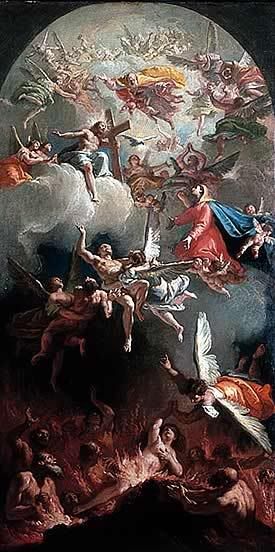
For many, whether purgatory is Biblical is something of a no-brainer. After all, the word "purgatory" appears nowhere in the Bible. Which puts it in the company of other words, such as "Trinity,""Incarnation," or even, that curious belief known as "the Rapture."
Although the word purgatory does not appear in the Bible, it refers to a concept that is Biblical. The Bible refers to a time where our works will be tested by fire. It is a time of purification, where our sins will be purged from our souls, so that we will enter heaven purified. Over time, this time of "purging" became known as "purgatory."
1 Cor 3:13-15: Every man's work shall be made manifest: for the day shall declare it, because it shall be revealed by fire; and the fire shall try every man's work of what sort it is.
If any man's work abide which he hath built thereupon, he shall receive a reward.
If any man's work shall be burned, he shall suffer loss: but he himself shall be saved; yet so as by fire.
This indicates that even though a man's work was burned and he suffered loss, he was saved. This is not the all or nothing of heaven or hell, but a purification before entering heaven.1 Peter 1:7: That the trial of your faith, being much more precious than of gold that perisheth, though it be tried with fire, might be found unto praise and honour and glory at the appearing of Jesus Christ
Jude 23: And others save with fear, pulling them out of the fire; hating even the garment spotted by the flesh.
So, if purgatory is Biblical, does it follow that our prayers make any difference to those are being purified?
2 Tim. 1:16-18 is an example of Paul praying for the dead, in this case, a man named Onesiphorus.
Praying for the dead was common practice among the Jews at that time. It has been the practice at least as long as the time of the Maccabees. 2 Maccabees 12:43–45 states "In doing this he acted in a very excellent and noble way, inasmuch as he had the resurrection of the dead in view; for if he were not expecting the dead to rise again, it would have been useless and foolish to pray for them in death. But if he did this with a view to the splendid reward that awaits those who had gone to rest in godliness, it was a holy and pious thought. Thus he made atonement for the dead that they might be freed from this sin." These verses are the primary reason that the deuterocanonical books were removed from the Old Testament. They justified praying for the dead.
Praying for the dead remains the Jewish practice today. Orthodox Jews recite the Kaddish for eleven months after the death of a parent, to pray for their purification. Judaism 101 says "According to Jewish tradition, the soul must spend some time purifying itself before it can enter the World to Come."
While many contend that purgatory and praying for the dead was a medieval Roman Catholic invention, there is ample evidence that this was a belief of the early Christians. Visit the catacombs, and you find prayers for the dead scrawled on the wall in examples of graffiti dating to the first three centuries of Christianity.
Other writings of that era such as Acts of Paul and Thecla and the Martyrdom of Perpetua and Felicity also attest to this belief.
The Early Church Fathers, who, being "early" predated Medieval times by quite a bit, also wrote on this topic. Tertullian, writes in the second century, "We offer sacrifices for the dead on their birthday anniversaries [the date of death—birth into eternal life]."
Gregory of Nyssa, writing in the late third century, says ""If a man distinguish in himself what is peculiarly human from that which is irrational, and if he be on the watch for a life of greater urbanity for himself, in this present life he will purify himself of any evil contracted, overcoming the irrational by reason. If he has inclined to the irrational pressure of the passions, using for the passions the cooperating hide of things irrational, he may afterward in a quite different manner be very much interested in what is better, when, after his departure out of the body, he gains knowledge of the difference between virtue and vice and finds that he is not able to partake of divinity until he has been purged of the filthy contagion in his soul by the purifying fire."
You can read more excerpts of these early Christian writers here.
So, to summarize Catholic teaching on purgatory in a Biblical way:
We must be spotless and pure in God's presence.
Rev 21:27
Matt 5:8
Christ promised there was punishment that exacted what was due but wasn't endless. (And Paul supported this teaching.)
Matt 5: 20-26
Matt 12:32
Matt 18:21-35
Matt 25:31-46
Luke 12:58-59
Heb 9:27
Psalm 99:8
This punishment isn't in Hell because you can't be saved through hellfire. Also, there's no punishment in Heaven.
1 Corinthians 3:10-16
2 Corinthians 5:9-11
Hebrews 12:6, 11
Those who are alive can pray for those who are dead (and vice versa).
1 John 5:16-17
Luke 16:19-31
2 Maccabees 12:38-46
Sirach 7:33
To end, I think a quotation from C.S. Lewis from Letters To Malcolm is in order.
"Of course I pray for the dead. The action is so spontaneous, so all but inevitable, that only the most compulsive theological case against it would deter me. And I hardly know how the rest of my prayers would survive if those for the dead were forbidden. At our age, the majority of those we love best are dead. What sort of intercourse with God could I have if what I love best were unmentionable to him?
I believe in Purgatory.
Mind you, the Reformers had good reasons for throwing doubt on the 'Romish doctrine concerning Purgatory' as that Romish doctrine had then become.....
The right view returns magnificently in Newman's DREAM. There, if I remember it rightly, the saved soul, at the very foot of the throne, begs to be taken away and cleansed. It cannot bear for a moment longer 'With its darkness to affront that light'. Religion has claimed Purgatory.
Our souls demand Purgatory, don't they? Would it not break the heart if God said to us, 'It is true, my son, that your breath smells and your rags drip with mud and slime, but we are charitable here and no one will upbraid you with these things, nor draw away from you. Enter into the joy'? Should we not reply, 'With submission, sir, and if there is no objection, I'd rather be cleaned first.' 'It may hurt, you know' - 'Even so, sir.'
I assume that the process of purification will normally involve suffering. Partly from tradition; partly because most real good that has been done me in this life has involved it. But I don't think the suffering is the purpose of the purgation. I can well believe that people neither much worse nor much better than I will suffer less than I or more. . . . The treatment given will be the one required, whether it hurts little or much.
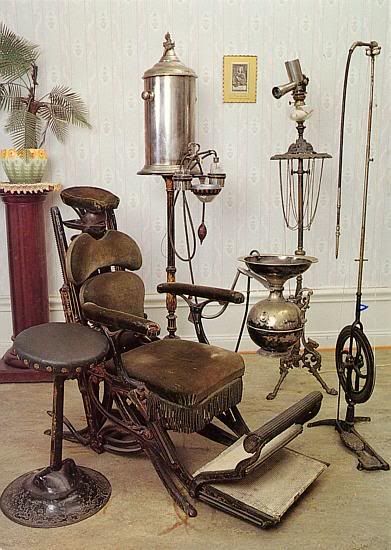
My favourite image on this matter comes from the dentist's chair. I hope that when the tooth of life is drawn and I am 'coming round',' a voice will say, 'Rinse your mouth out with this.' This will be Purgatory. The rinsing may take longer than I can now imagine. The taste of this may be more fiery and astringent than my present sensibility could endure. But . . . it will [not] be disgusting and unhallowed."
Friday, September 14, 2007
A Kelly Series
While Candy is back to writing about the domestic arts, a topic at which she excels, I also plan to write up some apologetics posts.
Amy from Blessed Motherhood, who comments here as motherofmany, was kind enough to send me two books written from the point of view of former Catholics. One is Far From Rome, Near To God and the other is The Truth Set Us Free, both published through Berean Beacon. Both books are compiled of testimonies, the former from men who used to be priests and the latter from former nuns. One would hope that priests and nuns would fully understand the Catholic faith, but apparently, that is not always the case.
In reading the stories, often they make the same points over and over. I would like to address the frequently occurring points, because they are also often the most mischaracterized aspects of the Catholic Church.
To deal with a first quick example, let's talk about paying to have a Mass said for someone who has died. People often claim that this is a reason why the Catholic Church is so rich.
First, no one is required to have a Mass said for the dead. The dead are not "held hostage" until their families can raise enough money. The Mass is a form of prayer, and so this is another form of prayer for the dead, which is a practice encouraged by the Church.
(For additional information on praying for the dead, I suggest looking here and here.)
Second, no one is required to pay for the Mass. We have what is a suggested offering, but if you can't pay, you will not be turned away.
If the Church is accumulating wealth by these Masses, how much do you think the suggested donation must be? A lot, huh? Nope. A mere $5 is the norm.
Let's do some math here. Say there is one Mass a day Monday through Friday, and two a each on Saturday and Sunday. At $5 a Mass, that would be $45 a week, or $2340 a year. I attend a small parish, and our operating budget is $5000 per WEEK. A whole year's worth of Masses at my church will pay for half of one week's budget.
In fact, it's pretty cold where I am, so we probably spend that much on heating alone. Let me tell you, those big stone churches are drafty and mighty expensive to heat. That is pretty typical of the supposed wealth of the Catholic Church. Most of it is held in things such are buildings and art, which bring in no income, but have a lot of upkeep. Restoring the Sistine Chapel was not cheap.
In fact, the operating budget of the Vatican is a mere $300 million dollars. Think that "mere" is misplaced? General Motors reported assets of $455 billion in 2003.
If anyone has any burning questions, feel free to post them in the comments section. Although there are certain topics that I definitely want to cover, I don't have a particular order in mind. So, if someone really wants to hear more about faith versus works, which is already being discussed in comments, I can start in on that.
Subscribe to:
Posts (Atom)